
Rescue Diver Course in Singapore: PADI, $838, Small Classes
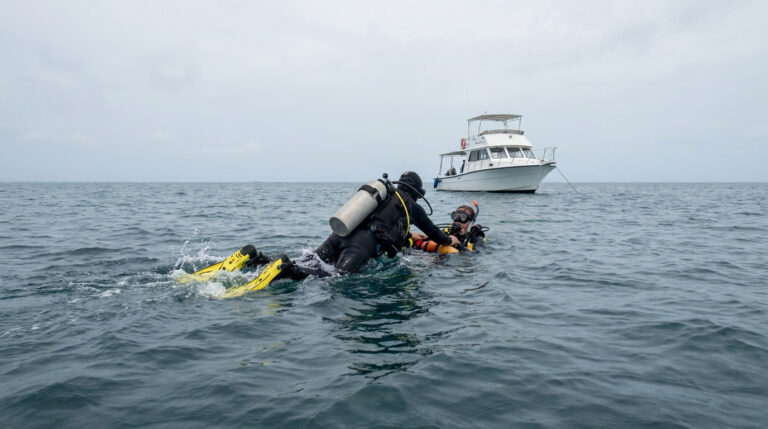
The PADI Rescue Diver course in Singapore costs $838 with us: certification, eLearning, full equipment use, a confined water session and four training dives at Singapore’s local sites, all included, in classes of 4 to 5 divers. To start you need an Advanced Open Water certification (or an equivalent) plus first aid and CPR training within the last two years; both prerequisites are covered in detail below. PADI describes Rescue Diver as “one of the most rewarding and challenging continuing education scuba certifications”, and its own course page notes that countless divers name it their favourite. It is the course where diving stops being only about you and becomes about the divers around you.
| Course at a glance | Details |
|---|---|
| Price | $838, no hidden extras for the training itself |
| Class size | Only 4 to 5 students per course |
| Prerequisites | Advanced Open Water (or equivalent), plus first aid and CPR within the previous two years |
| Schedule | Day 1 online eLearning; Days 2 and 3 dive training at Hantu or Lazarus |
| Dates | Flexible to suit your schedule; minimum 2 pax to sign up for a weekday run |
| Booking | Book the PADI Rescue Diver course online |
What does the $838 Rescue Diver course include?
Everything the training itself requires. The fee covers your PADI Rescue Diver certification, the PADI online material, use of all scuba equipment, four training dives plus a confined water session, and the instructor fee. You bring yourself and your prerequisites; we bring the rest.
The exclusions are the honest small print: meals, beverages and insurance cover are not included. That is the complete list.
The price is the same flat $838 we charge for the Open Water course and the Advanced Open Water course, so there is no cost penalty for continuing your education; each step up the ladder costs the same as the one before it.
What are the prerequisites for the PADI Rescue Diver course?
Two real requirements, one age rule, and the usual health baseline.
- Certification: PADI Advanced Open Water Diver or an equivalent certification from another agency. PADI also accepts Adventure Diver with the Underwater Navigation Adventure Dive completed. If you are still an Open Water diver, do the Advanced Open Water course first; it is also $838 and runs at the same local sites.
- First aid: Emergency First Response (EFR) Primary Care (CPR) and Secondary Care (First Aid) training, or a qualifying equivalent, completed within the previous 24 months. We do not list a standalone first aid course on the store, so if yours has lapsed or you have never done one, message us on WhatsApp at 9800 0539 and we will arrange the first aid portion around your course dates.
- Age: minimum 12 years old; divers certified between 12 and 14 earn Junior Rescue Diver.
- Health: in good health, reasonably fit, and comfortable in the water.
How the course runs: theory, ten exercises, two scenarios
Rescue Diver has three components. First, knowledge development through self-paced eLearning, which is Day 1 of our itinerary and happens wherever you like. Second, rescue training exercises in the water. Third, open water rescue scenarios that put it all together.
The in-water work starts with a self-rescue review, because you cannot help anyone while you are the problem: cramp release, surface buoyancy, airway control, alternate air source use, and overcoming vertigo. Then come the ten rescue exercises:
- Tired Diver
- Panicked Diver
- Assisting a Responsive Diver from Shore, Boat or Dock
- Distressed Diver Underwater
- Missing Diver, using search patterns
- Surfacing an Unresponsive Diver
- Unresponsive Diver at the Surface, with in-water rescue breaths and towing
- Exiting an Unresponsive Diver
- First Aid for Pressure-Related Injuries and Oxygen Administration
- Response from Shore or Boat to an Unresponsive Diver
The distinction between exercises one and two matters more than the names suggest. A tired diver is rational: you approach, reassure and tow. A panicked diver is not rational, so you learn approach and control techniques that keep you safe while you take charge of someone who is actively working against you at the surface.
The final assessment is two open water rescue scenarios that act as the in-water exam: rescuing an unresponsive diver underwater, and managing an unresponsive, non-breathing diver at the surface from evaluation through tow, in-water rescue breathing, equipment removal, exit and simulated CPR.

How long does the Rescue Diver course take?
The eLearning is self-paced, so Day 1 takes as long as you give it; most people spread it over evenings in the week before diving. The practical training and open water scenarios take about two days, which is exactly how our itinerary runs: Days 2 and 3 are dive training at Hantu or Lazarus. If you need first aid training first, add roughly one more day, which brings a complete package to around three to four days end to end.
Dates are flexible to suit your schedule, and weekday runs go ahead with a minimum of two sign-ups. Weekends are the usual pattern for divers with office hours: theory done at home during the week, then two days in the water.
Why do divers call Rescue their favourite course?
PADI’s answer is on record: Rescue Diver teaches you to recognise and respond to dive emergencies while putting your mental and physical strength to the test, and countless divers tell PADI it is their favourite scuba course. Our answer is simpler. Every course before this one is about your own diving: your buoyancy, your navigation, your depth limits. Rescue is the first course about everyone else’s, and that shift builds a kind of confidence no depth rating can. You come out of it watching the water differently, noticing the diver who is kicking too hard at the surface or the buddy pair drifting apart, and knowing exactly what you would do about it.
Challenging, yes; PADI says so in the same sentence it uses the word rewarding. The exercises are physical, the scenarios are deliberately stressful, and that is precisely why finishing them feels the way it does.
Where Rescue sits on the PADI path
The ladder so far: Open Water certifies you to dive, Advanced Open Water takes you to 30 metres, and Rescue Diver makes you the diver other people are glad to share a boat with. The full progression, with prices and what each level unlocks, is laid out in our guide to diving courses in Singapore.
The skills also travel. Everything you practise at Hantu and Lazarus applies on every trip you take afterwards, whether that is a weekend at Tioman or further afield; rescue skills are the one piece of kit that weighs nothing in your luggage.
Frequently asked questions
How much does the Rescue Diver course cost in Singapore?
$838 with us, covering the PADI Rescue Diver certification, online material, use of all scuba equipment, four training dives plus a confined session, and the instructor fee. Meals, beverages and insurance are excluded. It is the same price as our Open Water and Advanced Open Water courses.
What are the prerequisites for the PADI Rescue Diver course?
Advanced Open Water Diver (or an equivalent certification from another agency), or Adventure Diver with the Underwater Navigation dive completed. You also need first aid and CPR training within the previous 24 months, a minimum age of 12, and to be in good health, reasonably fit, and comfortable in the water.
Do I need EFR or first aid before I can start?
Yes. EFR Primary Care (CPR) and Secondary Care (First Aid), or a qualifying equivalent, completed within the previous 24 months. If yours has lapsed, WhatsApp us at 9800 0539 before booking and we will arrange the first aid portion around your course dates.
How long does the PADI Rescue Diver course take?
The eLearning is self-paced; the in-water training takes about two days, run as Days 2 and 3 of our itinerary at Hantu or Lazarus. Add roughly one more day if you need first aid training first, so plan for around three to four days in total.
Is the Rescue Diver course hard?
It is meant to stretch you. PADI calls it one of the most rewarding and challenging continuing education certifications, and the scenarios test both mental and physical strength. With classes capped at 4 to 5 students, your instructor has time to drill each exercise until it sticks, which is why so many divers finish calling it their favourite course.
Where does the Rescue Diver course run?
Theory is online at your own pace. The confined session and four training dives happen at Singapore’s local sites, Hantu or Lazarus, over two days.
Can I do the course on weekdays?
Yes. Dates are flexible to suit your schedule, and weekday runs need a minimum of two people to sign up. Weekends run as normal.
Ready to become the diver everyone wants as a buddy? Book the PADI Rescue Diver course online, or WhatsApp us at 9800 0539 to line up dates and sort your first aid prerequisite. Prefer to talk it through in person? Come see us at 178 Paya Lebar Road, #03-03; we will map your path from your current certification to Rescue over the counter.