
Diving Knife and Line Cutter Guide for Singapore Divers
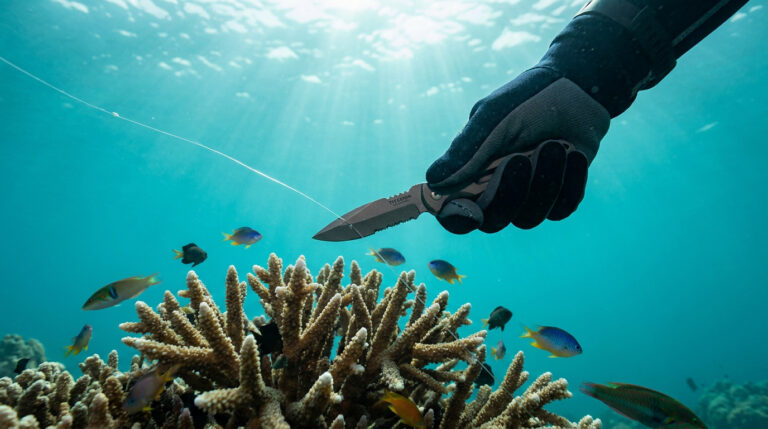
A diving knife is a full-blade tool for sawing, prying and general underwater work, while a line cutter is a compact hook-shaped blade built to slice fishing line and net in a hurry. Most divers around Singapore now carry a small line cutter as their primary rescue tool and a knife as backup, because the real entanglement hazard on our reefs is drifting monofilament and discarded net rather than kelp or rope. This guide explains the difference, the blade materials worth paying for, where to mount your tool, and which cutting tools we stock at our Paya Lebar shop.
Why every Singapore diver should carry a cutting tool
Our local dive sites sit under some of the busiest fishing and shipping traffic in the region. Sites like Pulau Hantu and Lazarus Island collect lost fishing line, hand lines and the occasional ghost net snagged on the reef structure. Monofilament is nearly invisible in low visibility, and it is exactly the sort of line that can wrap a fin, a first stage or a camera tray before you notice. A cutting tool turns a frightening entanglement into a ten second problem.
- Entanglement is the common threat. Fishing line and net cause far more diver snags in Singapore waters than rope or plant matter.
- Redundancy matters. Many instructors recommend carrying two cutting devices when you dive entanglement-prone sites, so a dropped tool is not the end of your options.
- It is a rescue tool, not a weapon. A dive knife is never for marine life. It is for freeing yourself or a buddy from line, net and webbing.
If you are still choosing where to get wet, our overview of where to dive from Singapore explains the local sites and the conditions you will actually face.
Diving knife versus line cutter: what is the difference
The two tools solve the same problem in different ways. A knife gives you reach, a sawing edge and a point for prying. A line cutter hides a small guarded blade behind a hook, so you can pull taut line into it without risking a nick to a hose, a wrist or a drysuit. A third option, EMT trauma shears, cuts thick webbing and cable ties cleanly and is popular with technical divers.
| Tool | Best at | Weakness | Who it suits |
|---|---|---|---|
| Line cutter | Fast, safe cuts on monofilament and thin net; guarded blade | Useless on thick rope or hard material | Every recreational diver as a primary tool |
| Dive knife | Sawing, prying, cutting rope and net; a point for leverage | Bulkier; exposed edge needs a sheath | Divers who want one do-everything backup |
| Trauma shears | Slicing webbing, straps and cable ties | Slow on loose line in current | Technical and wreck divers |
The practical answer for most people is simple: clip a line cutter where you can reach it with either hand, then carry a compact knife as your second tool.
Titanium versus stainless steel versus plastic blades
Blade material decides how much maintenance your tool demands and how long it lasts in warm salt water. There is no single winner, only trade-offs.
- Titanium. Rustproof, light and low maintenance, which is a real advantage for warm-water salt diving where corrosion is relentless. It holds an edge well but is harder to sharpen at home, and it costs more up front.
- Stainless steel. Cheaper, common and easy to sharpen, and a hard stainless blade stays keen for a long time. The catch is corrosion: skip the freshwater rinse a few times and you will see spotting.
- Plastic or composite line cutters. Some cutters use a replaceable metal blade in a moulded body. They are inexpensive, will never rust in the body, and you swap the blade when it dulls.
For a diver logging steady salt-water dives every year, titanium usually wins on total cost because you are not replacing a corroded stainless blade every couple of seasons. If you dive occasionally and rinse everything carefully, stainless is perfectly sensible.
How to choose your dive knife or line cutter
Work through these features in order and you will land on the right tool for how you actually dive.
- Blade type. A part-serrated edge saws through line and net faster than a plain edge. For a cutter, a hooked, guarded blade is safest.
- Tip. A blunt or drop-point tip is the sensible default. It still pries and taps a tank, but it will not stab your BCD bladder or a drysuit seal by accident.
- Size. Big knives look reassuring and then live in a drawer. A compact tool you always clip on beats a large one you leave at home.
- Material. Titanium for low maintenance, stainless for easy sharpening, composite for a cheap dedicated cutter.
- Mount and sheath. The sheath must lock the tool in place yet release with one hand, in gloves, without looking. Test the draw before you buy.
Where to mount your cutting tool
The old habit of strapping a big knife to the outside of your calf is out of favour, because that is precisely where trailing line snags first. Modern placement keeps the tool small, central and reachable by either hand.
- BCD waist or chest. Clip a line cutter to a shoulder D-ring or the waist belt so either hand can find it.
- Inner calf. If you prefer a leg-mounted knife, put it on the inside of the calf where it is less exposed to line.
- Backup on a pocket or spool. Many divers tuck a second cutter into a wetsuit pocket alongside a wet note and a spool.
Whatever you choose, practise drawing and stowing it during your buddy check so the motion is automatic. Our dive guides library covers pre-dive checks and kit configuration in more depth.
Recommended cutting tools at our Singapore shop
We keep affordable, dive-ready cutting tools in stock and reference only what we actually sell. Prices are in Singapore dollars and current at the time of writing.
- AKUANA Seahorse line cutter diving knife (S$20). A compact, guarded line cutter that makes an ideal primary rescue tool. Small enough to clip on every dive and cheap enough to own two.
- AKUANA SWIFT titanium knife (S$60). A rustproof titanium blade for divers who want a low-maintenance backup that saws line and net and never needs rust treatment.
A cutting tool works best as part of a small self-rescue kit. Consider pairing it with an AKUANA Ostrich 3 SMB (S$80) for surfacing signalling, an AKUANA Spider 30 spool (S$25) to deploy it, and an AKUANA wet note (S$39) for underwater communication. Together these cover the situations where a cutter alone is not enough.
Care, maintenance and the law
Cutting tools are simple to look after, and a little routine keeps them dive-ready for years.
- Rinse in fresh water after every dive, then dry fully before storing, especially for stainless blades.
- Sharpen or replace when the edge drags. A blunt cutter is worse than useless because it gives false confidence.
- Check the sheath and clip for cracks and worn retention. A tool that falls out mid-dive is a tool you do not have.
- Travel sensibly. Pack knives in checked luggage, never carry-on, and be aware that carrying a knife in public is regulated in Singapore. It belongs in your dive bag, not your pocket on land.
Confident tool handling is part of good training. If you want to build the skills that make a cutting tool second nature, our PADI diving courses in Singapore run in small classes with local training dives at Pulau Hantu and Lazarus Island.
Frequently asked questions
Do I really need a dive knife for recreational diving?
You need a cutting tool, though not necessarily a large knife. For most recreational diving around Singapore a small guarded line cutter is enough, because the common hazard is fishing line and thin net rather than heavy rope. Carrying two small cutters gives you redundancy without the bulk of a big knife.
Titanium or stainless steel: which should I buy?
Choose titanium if you dive salt water regularly and want a rustproof, low-maintenance blade you will not have to replace. Choose stainless if you dive occasionally, rinse your gear carefully, and want a keen edge that is easy to sharpen at home. Both cut line perfectly well; the difference is corrosion resistance and cost.
Where should I mount my line cutter?
Somewhere you can reach with either hand and see without contorting, such as a shoulder D-ring, the waist belt, or a wetsuit pocket. Avoid the outer calf, since that is where trailing line snags first. Practise the draw during your buddy check so it becomes automatic.
Can I bring a dive knife on a flight from Singapore?
Yes, but it must go in checked luggage, never in your carry-on. Knives are not allowed through airport security in the cabin. Also remember that carrying a blade in public is regulated in Singapore, so keep it stored in your dive bag and use it only for diving.
What is the difference between a line cutter and trauma shears?
A line cutter is a hook with a small guarded blade, ideal for slicing loose monofilament and thin net quickly and safely. Trauma shears cut thicker webbing, straps and cable ties cleanly and are popular with technical and wreck divers. Many divers carry a cutter for line and shears as a heavier-duty backup.