
Dive Regulator Guide: First Stage to SPG, with Singapore Prices

In a PADI poll asking divers which gear purchase they valued most, the regulator came first, with twice the votes of the dive computer. It is also the piece with the most jargon per dollar: balanced, DIN, environmentally sealed, octopus. This guide translates all of it into plain English, with the real Singapore prices from our shelf, so you know what you are paying for and what you can skip.
The parts, in plain English
- First stage: the metal block that clamps to the tank valve. It steps tank pressure (around 200 bar) down to an intermediate pressure of roughly 8-10 bar above ambient. Its high-pressure port feeds your gauge; its low-pressure ports feed the second stages and your BCD inflator hose.
- Second stage: the part in your mouth. It drops that intermediate pressure to exactly the surrounding water pressure, on demand, each time you inhale.
- Octopus: a second, backup second stage on a longer hose, coloured high-visibility yellow so an out-of-air buddy finds it fast. Mechanically it does the same job as your primary.
- SPG (submersible pressure gauge): your fuel gauge. It reads tank pressure through a dedicated high-pressure hose off the first stage, and it is the one instrument you never dive without.
Balanced vs unbalanced: what the word buys you
In an unbalanced first stage, tank pressure pushes directly on the valve, so breathing effort creeps up as the tank drains and as you go deeper. A balanced first stage cancels that influence out: inhalation feels the same at 50 bar as at 200, at 30 metres as at 5. In other words, “balanced” buys you consistent easy breathing exactly when it matters most, deep and low on gas. Nearly everything on our wall is balanced; the word to actually check on a budget set is this one.
DIN or yoke?
Yoke (also called INT or A-clamp) clamps over the tank valve with the sealing o-ring exposed on the valve face; it is rated to about 232 bar. DIN threads into the valve with the o-ring captured inside the connection: more secure, slimmer, rated up to 300 bar, and the standard in Europe and technical diving.
The Southeast Asia reality: rental tanks in Malaysia, Thailand, Indonesia, and the Philippines are overwhelmingly yoke, and some island shops stock no adapters at all. So either buy yoke outright for pure regional travel, or buy DIN plus a screw-on DIN-to-yoke adapter (about 0.3 kg, no tools needed) if technical diving or European trips are anywhere in your future. An $18 DIN protector keeps the threads clean between dives.
Environmental sealing: mostly not your problem
A sealed first stage keeps water out of the spring chamber so it cannot freeze and jam the valve, a real risk in water below about 10°C because expanding air chills the first stage below zero. In the 26-30°C water of Southeast Asia, freezing is not a thing; the only warm-water benefit of sealing is keeping salt and silt out of the mechanism between services. Do not pay a premium for cold-water sealing you will never use; do pick it if Japan, southern Australia, or temperate wrecks are on your list.

How much does a dive regulator cost in Singapore?
From our shelf, complete first-plus-second-stage sets fall into three honest bands:
| Band | What you get | Examples from stock |
|---|---|---|
| $630-900 | Solid recreational sets that will outlast your first hundred dives | Oceanic Regulator Set ($632.50), Atomic Z3 ($655), AKUANA OW package (from $760), Atomic B2 ($815), Hollis LX ($885.50) |
| $1,000-1,450 | The proven workhorses most instructors dive | Scubapro MK25 EVO S600 ($1,050), MK25 EVO G260 ($1,065), MK25 EVO S620Ti ($1,265), MK25 EVO A700 ($1,425) |
| $1,800-3,400 | Titanium and top-of-line builds for people who know exactly why | MK25 EVO G260 Black Tech ($1,845), Atomic T3 Titanium ($1,995), Scubapro MK25T EVO S620 X-Ti ($3,340) |
Around the set itself: a yellow octopus or a combo set like the Atomic B2 with Z2 Octopus ($1,015); or replace the octopus entirely with an inflator-integrated alternate air source like the Scubapro Air 2 ($380) or Atomic SS1 (from $370). Gauges and hoses: AKUANA Hippo 1 SPG ($90), low pressure hoses from $46.
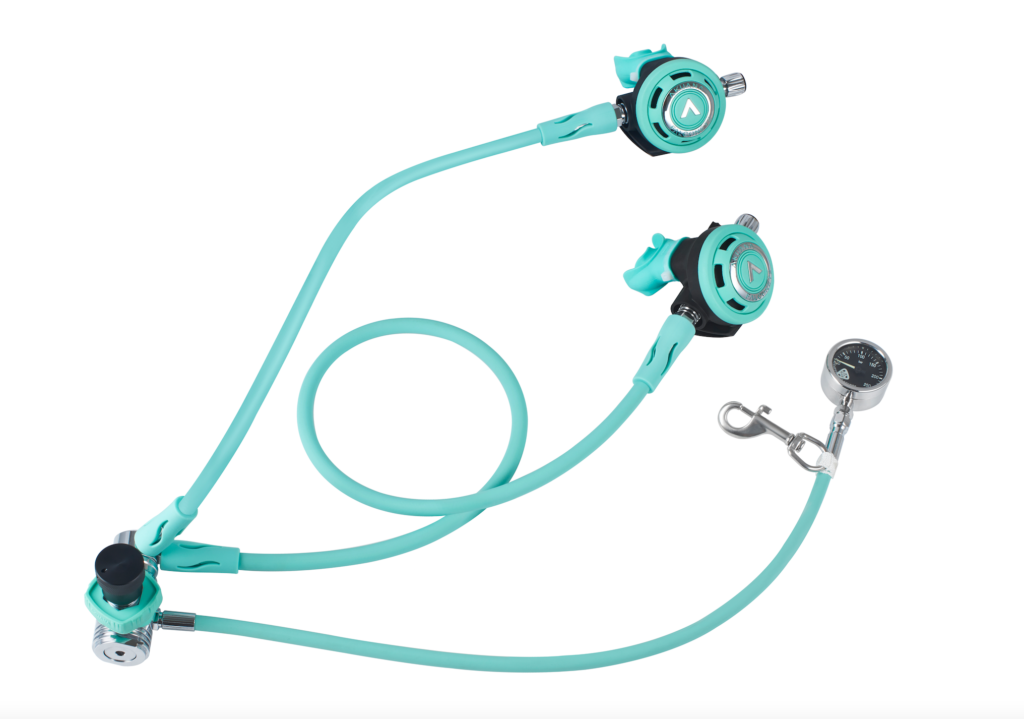
The AKUANA range: packages by diving style
AKUANA is the brand our customers search for most, and the reason is the package logic: instead of picking stages piecemeal, you buy a preassembled setup matched to how you dive, serviced and supported locally.
- OW package (from $760): the recreational starting point; the F3+FN2 combo ($760) pairs an Italian-made first stage with two air-balanced second stages.
- Hogar package ($800): long-hose DIR/Hogarthian routing that makes gas sharing straightforward.
- Sidemount package ($1,050) and doubles package (from $1,200): redundant setups for sidemount and twinset divers.
- Stage package (from $486): preassembled for stage and deco bottles.
- Building your own: the Falcon5 (from $309) and Osprey 3 ($296) first stages are both designed for polluted and cold-water environments, paired with the Falconet 2 second stage (from $169).
Servicing: the part people skip, then regret
The rule of thumb is an annual inspection, plus a full overhaul on the manufacturer’s schedule, whichever of months or dives arrives first, keeping the paperwork throughout. By brand: Scubapro runs 24 months or 100 dives; Aqua Lung and Apeks want annual inspection with a complete overhaul every two years; Atomic Aquatics stretches to two years or 300 dive hours, and three years on its titanium models. An overhaul replaces every soft part (o-rings, diaphragms, filter) and re-tunes both stages with pressure and leak testing. Skipping the schedule can void the warranty and any parts-for-life program, which is a lot to trade for postponing a service.
Why own one at all?
Three reasons that survive scrutiny. Hygiene: a rental mouthpiece is the one piece of gear strangers have chewed on all season, and while shops sanitise, you cannot verify it. Service history: with your own set you know exactly when it was overhauled and how it was rinsed and stored; with a rental you know nothing. Familiarity: your own mouthpiece stops jaw fatigue, and consistent hose routing means no fumbling in the one situation where fumbling matters. It is why that PADI poll put the regulator first.
Frequently asked questions
What is an SPG in diving?
The submersible pressure gauge: an analogue dial on a high-pressure hose that shows how much gas is left in your tank, in bar. Every regulator setup needs one (or a transmitter feeding an air-integrated computer). Compact versions like the AKUANA Hippo 1 ($90) suit sidemount and stage bottles.
What is an octopus regulator, and do I need one?
A backup second stage on a longer yellow hose, there so an out-of-air buddy can breathe from your tank. Recreational training assumes you carry one, so yes. The alternative is an inflator-integrated unit like the Scubapro Air 2, which folds the backup into your BCD inflator and removes one hose.
How much should I spend on my first regulator?
The $630-900 band covers a new recreational diver completely: balanced breathing, serviceable locally, no cold-water extras you will not use. Spend up for titanium or top-line builds when you know why (travel weight, tech diving ambitions), not because the wall display escalates.
DIN or yoke for Tioman and Southeast Asia trips?
Yoke, or DIN with an adapter permanently in your save-a-dive kit. Regional rental tanks are overwhelmingly yoke, and counting on a dive shop in the islands to lend you an adapter is how surface intervals get ruined.
How often does a regulator need servicing?
Annual inspection as a baseline; overhaul per your brand’s schedule (Scubapro 24 months or 100 dives, Atomic two years or 300 hours, Aqua Lung and Apeks two years). We service what we sell; bring the paperwork and we keep the history with the unit.
Do you have sidemount setups?
Yes: the AKUANA sidemount package ($1,050) and the Scubapro G260 sidemount kit ($2,305), plus stage packages and compact SPGs to finish the rig.
Browse the full range with live stock at regulators, SPGs and hoses. Completing the kit? The BCD buying guide and dive computer guide cover the other two big purchases, and every set we sell can be tried, fitted, and serviced at 178 Paya Lebar Road.