
Scuba vs Snorkelling: Which Should You Learn First?
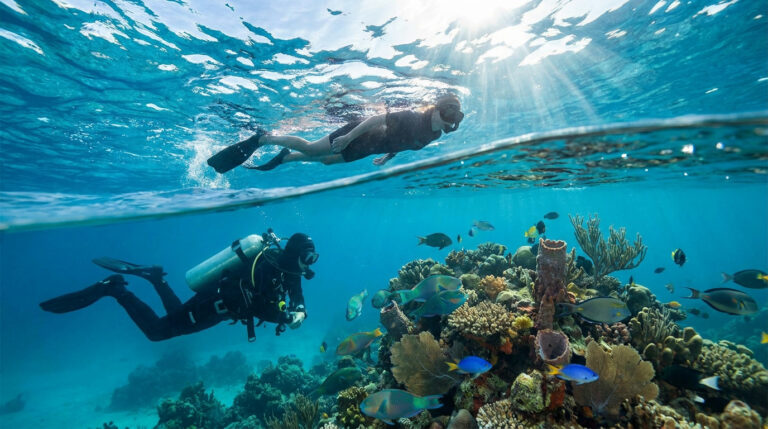
If you only want a taste of the reef and you want it today, learn to snorkel first: it takes about fifteen minutes, needs no certification, and costs almost nothing. If your real goal is to breathe underwater and stay down with the fish, skip ahead and go straight to a scuba course, because snorkelling is not a prerequisite and it does not shorten your training. Most people are happiest doing both, in that order, and this guide explains exactly when each one makes sense.
What is the real difference between snorkelling and scuba diving?
Both let you look at the underwater world, but they are very different activities. Snorkelling keeps you at the surface, breathing through a tube while you float face down and look at whatever passes below. Scuba diving gives you a cylinder of compressed air and a regulator, so you breathe normally while fully submerged, usually for thirty to forty-five minutes per dive. One is a relaxed surface pastime you can pick up on any beach holiday. The other is a trained skill with a recognised certification behind it.
| Factor | Snorkelling | Scuba diving |
|---|---|---|
| Where you are | At the surface, looking down | Fully submerged |
| Breathing | Through a snorkel tube | Regulator and air cylinder |
| Typical depth | 0 to 6 metres | 12 to 18 metres on entry-level dives |
| Time in the water | As long as you like | 30 to 45 minutes per dive on air |
| Training needed | A quick briefing | Formal certification course |
| Minimum age | Any age with supervision | 10 years for entry-level scuba |
| Best for | Casual reef viewing, water confidence | Exploring wrecks, marine life up close |
The case for learning to snorkel first
Snorkelling is the gentlest possible introduction to the ocean, and there are good reasons to start here.
- It is quick to learn. Someone shows you how to clear water from the snorkel, seal the mask and breathe steadily, and you are ready in a quarter of an hour.
- It builds water confidence. Getting comfortable with your face in the water and a mask on is exactly the comfort you will lean on later when you learn to dive.
- It is cheap and portable. A mask, snorkel and fins fit in a day bag, and there is no boat charter or air fill required.
- It suits everyone. Young children, non-swimmers in shallow water with a buoyancy aid, and anyone nervous about depth can all snorkel.
If you are unsure whether you even enjoy being in the sea, an afternoon of snorkelling answers that question cheaply before you commit to a course. Many divers we train started exactly this way.
The case for going straight to scuba
Here is the important myth to clear up: you do not need to snorkel before you learn to dive. Snorkelling experience is pleasant and helps your comfort in the water, but it does not replace any part of a scuba course, and you cannot skip lessons because you already snorkel. So if diving is your actual goal, there is no reason to delay.
Reasons to head straight for a scuba certification include:
- You want more than the surface. Snorkelling only shows you the top few metres. Reefs, walls and wrecks reveal themselves when you can descend and stay down.
- You want to breathe calmly underwater. Nothing about snorkelling teaches regulator breathing, buoyancy control or equalising, which are the real skills of diving.
- You learn faster with structure. A proper course teaches safety, gas planning and problem solving from the start, rather than picking up bad habits alone.
An entry-level certification is more accessible than most beginners expect. You can read more about the pathway on our PADI diving courses in Singapore page.
Skills, cost and time compared
The honest gap between the two activities is in commitment. Snorkelling asks for almost nothing. Scuba asks for a few days and a course fee, and rewards you with a lifelong qualification.
| Snorkelling | Scuba diving | |
|---|---|---|
| Time to get going | About 15 minutes | Around 3 to 4 days for Open Water |
| Certification | None | Recognised worldwide, for life |
| Core skills | Mask clearing, steady breathing | Buoyancy, equalising, regulator recovery, buddy skills |
| Entry cost | Cost of a mask and snorkel | A one-off course fee |
| Ongoing needs | Very little | Air fills, dive trips, occasional refreshers |
At our shop the PADI Open Water, Advanced and Rescue courses are each a flat S$838, which keeps the numbers simple when you are budgeting. Classes are small, with four to five students, so you get real attention rather than being lost in a crowd.
How to start scuba diving in Singapore
You can go from curious to certified without leaving the region. The typical path looks like this.
- Pick your entry-level course. The PADI Open Water Diver certification is the global standard for beginners and the qualification most dive centres worldwide ask to see.
- Do the theory and pool work. You cover knowledge development and confined-water skills in calm, shallow conditions before heading to open water.
- Complete your training dives locally. We run local training dives at Pulau Hantu and Lazarus Island, so you earn your certification in Singapore waters rather than needing to fly out first.
- Plan your first fun dives. Once certified, the region opens up. See our guide on where to dive from Singapore for nearby options and easy weekend trips.
The minimum age for entry-level scuba is ten years old, with depth limits for younger divers, so it genuinely is a family-friendly activity. If you want to read around the subject first, our diving guides cover courses, gear and dive sites in plain language.
Gear you actually need to begin
You do not need to buy a full dive kit on day one, and course fees usually cover the bulky rental equipment. The one area worth owning early is your personal fit items: a mask that seals to your face and a comfortable snorkel. These are the same pieces you use for snorkelling, which is another reason the two activities pair so well.
- A well-sealing mask. Comfort matters more than looks. Something like the Aqua Lung Sphera X mask at S$120 gives a wide, clear field of view for both snorkelling and diving.
- A reliable snorkel. A dry or semi-dry design keeps splashes out. The Scubapro Spectra Dry Snorkel at S$58 is a simple, dependable choice to start with.
- Fins that fit. Rental fins are fine at first, and you can invest in your own once you know you are hooked.
Buy the mask and snorkel, rent the rest, and upgrade later once you know your preferences. That keeps the initial outlay sensible while you find your feet.
So, which should you learn first?
If you want a low-cost, low-commitment window into the underwater world this weekend, snorkel first. If you are set on diving and want to spend real time below the surface, go straight to a scuba course, because snorkelling is not a required stepping stone. For most people the ideal answer is both: snorkel to build comfort and confidence, then certify to unlock the deeper, richer world that only scuba can reach. Whichever you choose, Singapore is a surprisingly good place to start.
Frequently asked questions
Do I need to know how to snorkel before I learn to scuba dive?
No. Snorkelling helps your comfort in the water, but it is not a prerequisite for a scuba course and it does not let you skip any lessons. You can enrol in an entry-level scuba certification directly if diving is your goal.
Is snorkelling or scuba diving safer for beginners?
Both are safe when you respect the basics. Snorkelling has fewer variables because you stay at the surface. Scuba adds depth and equipment, which is exactly why it is taught through a structured, certified course that builds your skills gradually.
How old do you have to be to start scuba diving?
The minimum age for entry-level scuba is ten years old. Divers aged ten and eleven have shallower depth limits and must dive with a professional or a certified parent or guardian, so it works well as a family activity.
Can I get certified to scuba dive in Singapore itself?
Yes. You can complete your theory, pool sessions and open-water training dives locally at sites such as Pulau Hantu and Lazarus Island, then use your worldwide certification anywhere. There is no need to travel abroad just to qualify.
Do I need to buy my own gear to try diving?
Not to start. Course fees usually include rental of the bulky equipment. It is worth owning a mask and snorkel early for comfort and hygiene, then buying fins and other items once you are sure you enjoy the sport.