
Equalising Your Ears When Diving: Techniques and Fixes
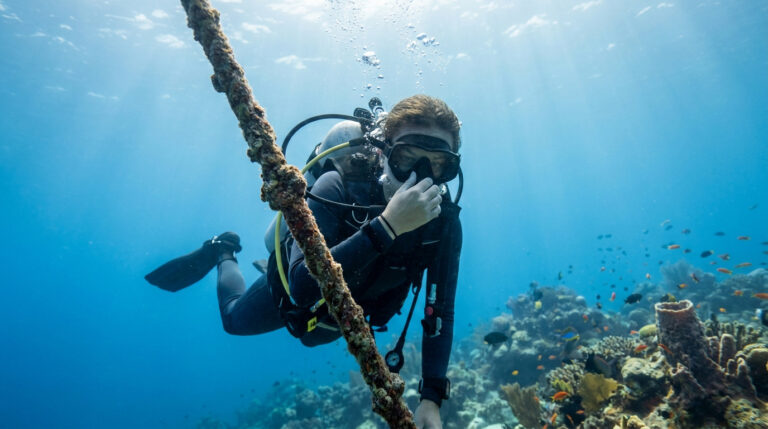
To equalise your ears while diving, add air to your middle ears before you ever feel pain: pinch your nose and blow gently (the Valsalva manoeuvre), or use the more efficient Frenzel technique, and repeat every metre or so as you sink. The golden rule is equalise early and equalise often, stay ahead of the pressure, and never force your way through ear pain. If an ear refuses to clear, stop, rise up a little, and try again before continuing down.
Why your ears hurt when you descend
Water is heavy, so pressure climbs fast as you go down. For roughly every 10 metres you descend, the pressure on your body rises by about one bar, the same weight as the entire atmosphere above the sea. The first 10 metres are the harshest of all: pressure doubles between the surface and 10 metres, which is exactly why most divers feel the pinch in the shallow part of the descent.
Your middle ear is a small air-filled space sealed behind the eardrum. As outside pressure rises, it presses the eardrum inward against that trapped air. Left alone, the squeeze becomes uncomfortable and then painful, and it can bruise or tear the eardrum. Equalising simply means pushing a little extra air up a narrow passage called the Eustachian tube, which runs from the back of your throat to the middle ear, so the pressure on both sides of the eardrum matches. Do that steadily and the pain never arrives.
The main ear equalising techniques
There is more than one way to open the Eustachian tubes, and different methods suit different divers. Most people learn the Valsalva first, then add gentler or more efficient techniques as they gain experience. Here is how the common ones compare.
| Technique | How you do it | Best for | Notes |
|---|---|---|---|
| Valsalva | Pinch the nose and blow gently against it | New divers, shallow descents | Easy to learn but can be forceful if overdone |
| Frenzel | Pinch the nose, close the throat, push the tongue up and back | Freedivers and experienced scuba divers | Efficient and gentle, but takes practice |
| Toynbee | Pinch the nose and swallow | Divers who struggle with blowing | Uses natural swallowing to open the tubes |
| Lowry | Pinch the nose, blow gently and swallow at the same time | Stubborn ears that need a combined nudge | Blends Valsalva and Toynbee |
| Voluntary tube opening | Flex the throat muscles to hold the tubes open | Naturally hands-free divers | Hardest to master; many people cannot do it |
A quick word on each in practice:
- Valsalva is the technique nearly every diver starts with. Pinch your nose through the nose pocket of your mask and blow as if gently clearing your nose. Keep it soft; a hard, sudden blow can do more harm than good.
- Frenzel separates the air push from your lungs and uses the tongue as a piston instead. It needs less effort, gives finer control, and works better at depth, which is why freedivers rely on it. It is well worth learning once the basics feel natural.
- Toynbee pairs a pinched nose with a swallow. Swallowing naturally opens the Eustachian tubes, so this is a good fallback when blowing alone will not clear a sticky ear.
- Lowry and voluntary tube opening are refinements. Lowry combines blowing and swallowing, while voluntary tube opening lets skilled divers keep the tubes open hands-free. Most recreational divers get by very well with the first three.
How to equalise properly, step by step
Technique matters less than timing. Divers rarely run into trouble because they picked the wrong manoeuvre; they run into trouble because they equalised too late. Follow this sequence on every descent.
- Pre-pressurise on the surface. Gently equalise once before you leave the surface. This gives you a small head start of extra air in the middle ear.
- Descend feet-first and slowly. Going down upright lets air rise naturally toward your Eustachian tubes, and a slow descent gives you time to keep up.
- Equalise every metre, before you feel pressure. Do not wait for discomfort. A gentle clear roughly every metre in the shallows keeps you permanently ahead of the squeeze.
- Stay gentle. If a soft effort does not work, do not blow harder. Ascend a metre, let the pressure ease, then try again more gently.
- Stop if it will not clear. An ear that refuses to equalise is telling you something. Go up until the pressure releases, try a different technique such as the Toynbee, and only continue when both ears are comfortable.
- Never push through pain. Pain means pressure is not balanced. Continuing down risks a burst eardrum and a very abrupt end to your dive trip.
Common equalising problems and how to fix them
Even experienced divers hit the occasional stubborn ear. Most problems have a simple fix once you know what is happening.
- One ear will not clear. Tilt your head so the blocked ear points toward the surface and try again. Lengthening that side of the neck often opens a lazy tube.
- You feel blocked from the start. Congestion from a cold, allergies, or even a heavy meal can swell the tube linings. If you cannot equalise on the surface, you will not manage it at depth. Call the dive rather than forcing it.
- Reverse block on the way up. Sometimes air struggles to escape the middle ear during ascent, causing pain as you rise. Slow down, pause, and let the trapped air work its way out gradually. Swallowing can help.
- Decongestant temptation. Many divers reach for a nasal spray or tablet. These can wear off underwater and trigger a reverse block, so they are not a reliable fix. If you regularly need medication to dive, see a doctor about the underlying cause.
- Diving with a cold. The simplest fix of all: do not. A blocked head above water becomes a blocked, painful head below it. Reschedule and your ears will thank you.
The small gear detail that makes equalising easier
You cannot pinch your nose without a mask that has a soft, moulded nose pocket, and a mask that seals poorly makes every part of the dive harder, equalising included. A comfortable, well-fitting mask such as the Gull Aqua Pro Mask at S$78 lets you reach the pinch position naturally without breaking the seal. Fit matters more than price here: come and try a few against your face before buying, because a mask that leaks or digs in will distract you at exactly the moment you need to focus on your ears. You will find more buying help in our diving guides.
Practising and getting coached in Singapore
Equalising is a skill, and like any skill it improves fastest with feedback. In an PADI Open Water course your instructor watches your descents, spots when you are leaving equalisation too late, and helps you build the habit of clearing early and often. Our courses run in small classes of four to five students at a flat S$838, so you get real attention rather than being one face in a crowd.
Most of our confined and open-water training happens on gentle local sites at Pulau Hantu and Lazarus Island, where the shallow, unhurried descents are ideal for practising equalisation without the pressure of a deep drop-off. Once the technique is second nature in these calm conditions, it carries over to any dive site you visit later. If you have wrestled with your ears before, tell your instructor early so they can slow your descents down and coach you through it.
Frequently asked questions
How often should I equalise while descending?
Aim to equalise gently about every metre, and always before you feel any pressure or pain. The first 10 metres need the most frequent clearing because that is where pressure changes fastest. Staying ahead is far easier than trying to catch up once your ears already ache.
Why can I equalise one ear but not the other?
The two Eustachian tubes do not always behave the same way, and one can be slower or slightly congested. Tilt your head so the blocked ear points upward and try again, which stretches that side and often opens the tube. If it still will not clear, ascend a little and repeat before going deeper.
Is it safe to dive with a blocked nose or a cold?
No. Congestion swells the linings of your Eustachian tubes and makes equalising difficult or impossible, which can lead to ear injury. If you cannot clear your ears easily on the surface, you should not dive that day. Reschedule and let the congestion pass first.
What should I do if my ears hurt at depth?
Stop your descent immediately and ascend a metre or two until the pain eases, then try to equalise gently again. Pain is a warning that pressure is not balanced, so never push deeper hoping it will sort itself out. If it will not clear at all, end the dive; a ruined eardrum ruins a whole trip.
Can I learn a better technique than the Valsalva?
Yes. The Frenzel technique uses your tongue rather than your lungs, needs less effort, and works better at depth, which is why freedivers favour it. It takes some dry-land practice to master. Ask your instructor to introduce it once your Valsalva feels comfortable and consistent.