
DIN vs Yoke Regulator: What to Buy in Singapore
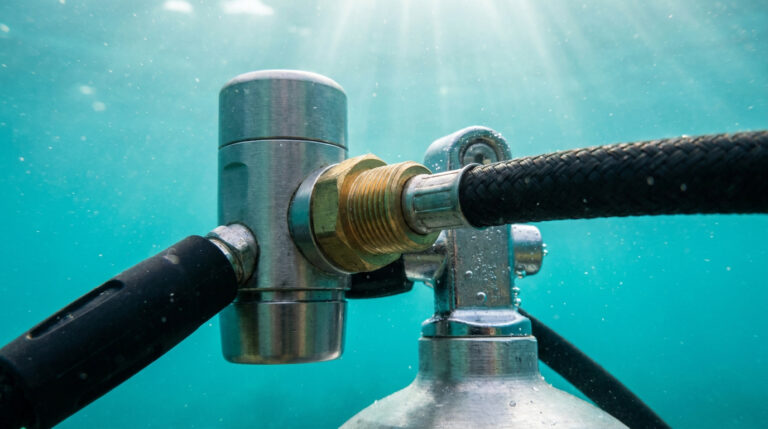
For most divers buying their first regulator in Singapore, a DIN first stage paired with a yoke (A-clamp) adapter is the most flexible choice. DIN is the safer, more secure fitting and is the standard for technical diving, while the adapter lets you clip onto the yoke rental cylinders that are common across Singapore and the wider region. If you only ever dive with a shop that hands you yoke tanks and you never plan to go technical, a plain yoke regulator is perfectly fine and slightly cheaper to run. The rest of this guide explains why, with real prices from our shop.
DIN vs yoke: the quick answer
The regulator’s first stage is the part that clamps onto your cylinder valve. There are two ways it can attach, and that single choice affects safety, pressure rating and where you can dive:
- Yoke (also called A-clamp or INT): a metal frame slips over the top of the valve and a hand screw presses the first stage against an o-ring that sits on the valve face. Simple, familiar, and the default on most tropical rental fleets.
- DIN: the first stage screws directly into the valve. The o-ring lives inside the regulator, captured behind the threads, so it is far better protected from knocks and grit.
Both deliver air to you exactly the same way once connected. The difference is entirely in how they mate with the tank.
How the two connections actually work
With a yoke setup, the o-ring is exposed on the cylinder valve. Every time a tank gets knocked, dropped or dragged across a boat deck, that o-ring is sitting out in the open. It is easy to inspect and cheap to replace, but it can also get pinched or extruded under pressure, which is the usual cause of a hissing leak at the valve.
With DIN, you thread the regulator into the valve and the o-ring is trapped inside the connection. That gives a cleaner, more positive seal and removes the most common leak point. It is also why the technical diving community standardised on DIN years ago. Nothing sticks out to snag on a wreck or in an overhead environment, and the connection simply feels more solid in the hand.
There is a pressure story too. Yoke fittings are generally rated to around 232 bar, while DIN comes in 232 bar and 300 bar versions. If you ever move to high-pressure steel cylinders, only DIN will safely take the 300 bar fill. A 300 bar DIN regulator will also seal correctly in a 232 bar valve, so the higher-rated thread is the more future-proof option.
DIN vs yoke compared
| Factor | Yoke (A-clamp) | DIN |
|---|---|---|
| How it attaches | Frame clamps over the valve, o-ring on the valve | Threads into the valve, o-ring inside the regulator |
| Typical pressure rating | Up to about 232 bar | 232 bar or 300 bar |
| O-ring protection | Exposed, easy to inspect but easy to knock | Enclosed, well protected |
| Best for | Warm-water recreational rental diving | Technical, cold-water, high-pressure and travel-flexible diving |
| Rental tank compatibility | Direct fit on most tropical fleets | Needs an insert or adapter on yoke-only fleets |
| Snag risk | Bulkier profile sticks up above the valve | Low profile, nothing protruding |
Which one suits Singapore and regional diving?
Here is the practical bit. Around Singapore and much of Southeast Asia, most recreational rental cylinders are set up for yoke. When you train on our PADI diving courses in Singapore or do local shore and boat dives at Pulau Hantu and Lazarus Island, the tanks handed to you will usually take a yoke connection straight away.
That does not mean you should buy yoke by default. A DIN regulator plus a small screw-in adapter gives you yoke compatibility whenever you need it, and drops the adapter off the moment you dive somewhere DIN-native, such as a technical facility, a cold-water trip or many European operations. It is the setup that never leaves you stuck at a fill station.
Choose accordingly:
- Pure warm-water holiday diver, always renting: yoke is simple and does everything you need.
- Buying once and keeping it for years: go DIN and carry an adapter. It covers every scenario.
- Eyeing technical, sidemount, wreck or cold water later: DIN is effectively mandatory, so start there.
Can you switch between DIN and yoke?
Yes, and this is what makes the decision low-stakes. There are two directions:
- DIN regulator onto a yoke tank: use a yoke adapter that screws onto your DIN first stage and converts it back to A-clamp. Compact, cheap and easy to pack.
- Yoke regulator onto a DIN tank: many DIN valves accept a removable insert that lets a yoke reg clamp on. If the shop has the insert, you are fine.
Some first stages are also convertible: a shop technician can swap the yoke block for a DIN block during a service. Whichever route you take, keep the threads clean and protected between dives. A simple DIN protector cap (S$18) keeps grit and salt out of a DIN first stage while it is off the tank, which matters far more on a threaded fitting than on an open yoke.
Regulators worth looking at in our shop
Most quality regulators are offered in both DIN and yoke, or as a convertible first stage, so you rarely have to compromise on the model you want. A few options across the range:
- Apeks XL4+ (S$755): a compact, cold-water rated travel workhorse that suits divers who want one regulator for local and overseas trips.
- Apeks XTX 50 (S$880): a step up in breathing performance with adjustable venturi, popular with divers heading towards deeper and technical diving.
- Atomic Aquatics Z3 (S$655): a smooth, low-maintenance option with a long service interval, good value for a first serious purchase.
- Scubapro MK25 EVO S620Ti (S$1265): a high-performance, titanium second stage set for divers who want a lifetime piece.
- Scubapro MK2 EVO R105 (S$470): a robust, budget-friendly first regulator that is easy to service.
- Akuana OW regulator package (S$760): a complete first-and-second stage plus octopus bundle if you want everything sorted in one go.
Not sure which model fits your diving? Pop into the shop at 178 Paya Lebar Road and try a few, or read more buying advice in our diving guides.
How to decide in one minute
- Only ever renting warm-water tanks and never going technical? Yoke is enough.
- Buying to keep, or diving in more than one country? Buy DIN and pack a yoke adapter.
- Cold water, sidemount, wreck or tech on the horizon? DIN, no debate.
- Still unsure? Choose DIN with an adapter. It costs a little more up front and removes every future compatibility worry.
Frequently asked questions
Is DIN or yoke safer?
DIN is generally considered the safer connection because the o-ring is enclosed inside the fitting rather than exposed on the tank valve. That protects it from knocks and reduces the risk of an o-ring blowing out under pressure. Yoke is still perfectly safe for recreational diving when the o-ring is in good condition and inspected before each dive.
Do Singapore rental tanks use DIN or yoke?
Most recreational rental cylinders in Singapore and around the region are set up for yoke. If you own a DIN regulator, carry a yoke adapter so you can clamp onto those tanks. Technical and specialist operators are more likely to run DIN valves.
Can I convert a yoke regulator to DIN later?
Often yes. Many first stages accept a conversion kit, where a technician swaps the yoke block for a DIN block during a service. It is cleaner to buy the fitting you want from the start, but conversion is a common and affordable option if your diving changes.
Will a DIN regulator work on a yoke tank?
Not directly, but a screw-in yoke adapter fixes that in seconds. Fit the adapter to your DIN first stage and it clamps onto a yoke valve like any A-clamp regulator. Take the adapter off again when you dive somewhere with DIN valves.
What pressure rating should I choose?
If you have any interest in high-pressure steel cylinders or technical diving, choose a 300 bar DIN regulator. It seals in both 232 bar and 300 bar valves, so it is the most future-proof option. A standard 232 bar rating is fine for typical recreational aluminium tanks.