
Scuba Hand Signals Every Diver Should Know
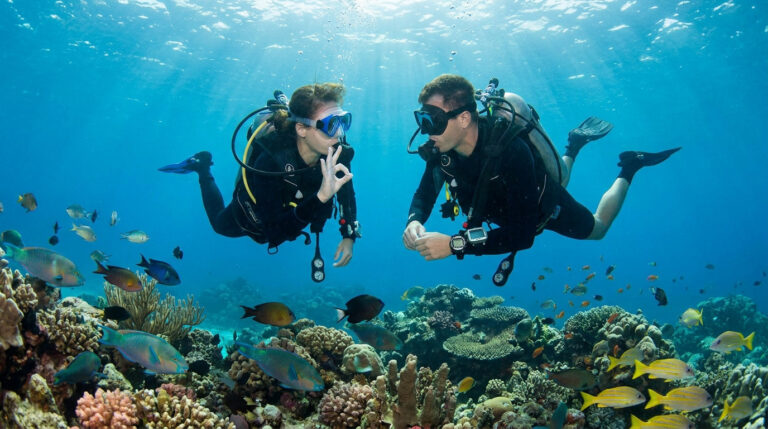
Scuba hand signals are the standardised gestures divers use to talk underwater, where a regulator makes speech impossible. Every diver should know a small core set: OK, stop, up, down, problem, low on air, out of air, and share air. These signals are recognised across PADI, SSI and most other agencies, so a diver trained in Singapore can buddy up with someone certified anywhere in the world and still be understood. Learn the core group below, agree on any local variations before you splash, and you will dive calmer and safer.
Why hand signals matter underwater
Sound does not carry the way it does on land, and you cannot pull the regulator out to shout. A clear set of agreed gestures is how buddies confirm they are fine, flag a problem early, and coordinate an ascent before a small issue becomes a big one. Good communication is one of the quiet skills that separates a relaxed diver from a stressed one, and it starts with signals you can make and read without thinking.
- Safety first: the fastest way to signal a problem or an out-of-air emergency is a gesture, not fumbling for a slate.
- Confirmation loop: a signal is a question and an answer. If your buddy flashes OK, you flash it back. Silence is not agreement.
- Shared language: because the core signals are standardised, they work whether you are diving Pulau Hantu or the Maldives.
- Calm dives: knowing you can be understood underwater lowers task loading and lets you enjoy the reef.
The essential scuba hand signals every diver should know
Start with the signals you will use on almost every dive. Make each one slowly and deliberately, hold it in your buddy’s line of sight, and wait for a reply. The table below covers the core group and how to make each one.
| Signal | How to make it | What it means |
|---|---|---|
| OK | Thumb and index finger form a circle, other three fingers up | “Are you OK?” or “I am OK.” Always answer it. |
| OK (gloved or distance) | Arm raised, hand touching the top of the head in a big circle | Same as OK, used when hands are far apart or across the surface |
| Stop | Flat palm held up, fingers together, facing your buddy | “Hold position. Do not move.” |
| Up / end the dive | Closed fist, thumb pointing up | “Let us ascend.” This is a direction, not the OK signal. |
| Down / descend | Closed fist, thumb pointing down | “Let us go down” or “the dive begins.” |
| Problem / something is wrong | Flat hand, palm down, rocked side to side | “Something is not right.” Follow with a point to the issue. |
| Slow down | Flat palm pushed slowly downward a few times | “Ease off, calm down, take it slower.” |
| Come here | Fingers or whole hand beckoning toward you | “Move closer to me.” |
Notice that thumb up and thumb down are directions to ascend or descend, never “good” or “bad.” Mixing up the thumbs-up with the OK circle is one of the most common beginner mistakes, so drill it until it is automatic.
Air and emergency signals
These are the signals you hope never to need in a hurry, which is exactly why they must be reflexes. Agree on them with your buddy during the pre-dive check, every single time.
- Low on air: a clenched fist drawn firmly into the centre of your chest. It tells your buddy you are getting low and the dive should start heading up.
- Out of air: a flat hand drawn across the throat in a slicing motion. This is the most urgent signal in diving and means “I have no air, share yours now.”
- Share air / give me your alternate: a hand moved toward your mouth in a breathing gesture, usually straight after the out-of-air signal.
- Check your gauge: point two fingers at your open palm, as if reading a dial, to ask “how much air do you have?”
If you see out of air, respond immediately by offering your alternate second stage. There is no time to hesitate, which is why this drill is repeated so many times in every entry-level course and refreshed in the PADI Rescue Diver programme.
Numbers and direction signals
Once buddies ask “how much air?” they need a way to answer. Air pressure is shown with number signals, usually in bar. The convention is simple:
- Tens: hold up fingers and tap the opposite flat palm, or show a closed fist for a full hundred, to indicate the tens of bar.
- Numbers one to five: straightforward finger counts.
- Numbers six to nine: shown by tapping fingers on the palm or crossing fingers, depending on the agency, so confirm the style on the boat.
Direction signals keep the team together. A flat hand angled like a knife points the way you want to swim, and a pointed finger indicates “look at that,” whether it is a turtle or a hazard. If you get separated, the standard rule is to search for no more than one minute, then ascend slowly and reunite on the surface.
Night dives and low-visibility communication
In the dark or in the green water common around Pulau Hantu and Lazarus Island, hand signals need light. On a night dive you signal by shining your torch onto your own hand, not into your buddy’s eyes, then making the gesture. You can also signal with the torch beam itself.
- OK with a torch: draw a slow circle on the seabed or a rock with the beam.
- Attention or problem: move the beam quickly back and forth in a fast side-to-side sweep.
- Never shine the light directly at another diver’s mask, as it destroys their night vision.
A dependable, compact torch is essential kit for this, and even a modest primary or backup light such as the Akuana J1000 diving light makes torch signalling clearer. When you surface, a bright delayed surface marker buoy tells the boat where you are, which is its own form of signalling. For messages that gestures cannot carry, a slate or Akuana wet notes lets you write a quick line to your buddy.
Recreational versus technical signals
The core recreational set above covers most dives. As you progress into deeper or overhead diving, the vocabulary expands and some gestures become more formal. The comparison below shows how the emphasis shifts.
| Aspect | Recreational diving | Technical diving |
|---|---|---|
| Core signals | OK, up, down, problem, air | Same core, plus gas switches and deco holds |
| Air reporting | Often on request, near turn pressure | Frequent, structured gas management checks |
| Touch contact | Rarely needed | Used in zero visibility and cave or wreck penetration |
| Light signals | Night and murky dives | Standard on most technical dives |
You do not need the technical vocabulary to enjoy local reefs, but knowing the recreational core is the foundation everything else builds on.
How to practise hand signals before your dive
Signals are muscle memory, so rehearse them out of the water first.
- Run the buddy check: during your pre-dive safety check, review OK, up, down, low on air, out of air, and any local variations.
- Agree the odd ones: confirm how you will show numbers and any signals your operator uses that differ from the textbook.
- Practise in the shallows: a small class means more attention, and our PADI courses run with just four to five students so you get real repetition.
- Keep looking at your buddy: a signal only works if it is seen, so stay within sight and glance across regularly.
For more skills to sharpen before your next trip, browse the full diving guides library, and when you are ready to log real dives, see where local training happens around Singapore’s southern islands.
Frequently asked questions
Are scuba hand signals the same across all training agencies?
The core signals for OK, up, down, problem, low on air and out of air are standardised and recognised across PADI, SSI, NAUI and most other agencies. Some number signals and regional gestures vary, so it is good practice to review them with your buddy and your dive operator before every dive.
What is the difference between the OK signal and a thumbs-up?
They mean completely different things. The OK signal is a circle made with the thumb and index finger, meaning “I am fine” or “are you fine?” A thumbs-up is a direction that means “let us ascend” or “end the dive.” Never use a thumbs-up to say you are OK, because your buddy may start heading to the surface.
How do I signal how much air I have left?
Your buddy asks by pointing two fingers at an open palm, like reading a gauge. You answer with number signals showing your remaining pressure in bar, for example five fingers then a closed fist for fifty. Because number styles differ slightly between agencies, confirm the method during your pre-dive check.
How do you communicate on a night dive?
You signal with your torch. Shine the beam onto your own hand and make the normal gesture, or draw a slow circle with the light to say OK and a fast side-to-side sweep to get attention. Never point the beam at another diver’s mask, as it ruins their night vision. A reliable dive light is essential kit for this.
Where can I learn scuba hand signals properly in Singapore?
You learn them as part of any entry-level certification. Our PADI Open Water, Advanced and Rescue courses run at a flat rate with small classes of four to five students, with training dives at Pulau Hantu and Lazarus Island where you practise every core signal in real conditions.