
PADI Divemaster in Singapore: The Pro Path
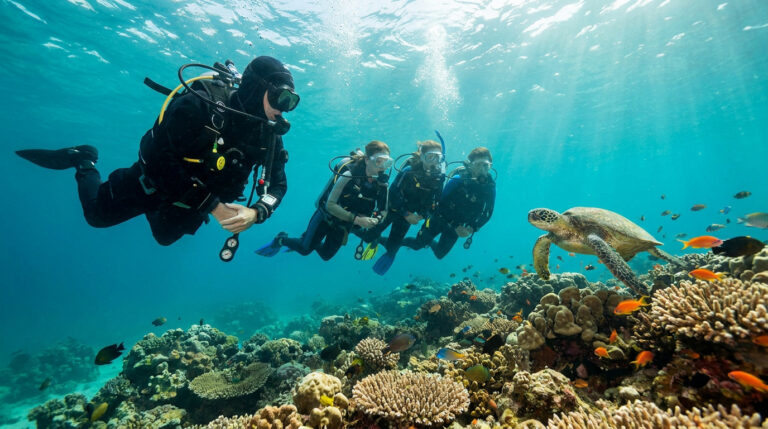
The PADI Divemaster is the first professional rating in recreational diving, and yes, you can earn it in Singapore. It sits one step above Rescue Diver and turns you from a capable recreational diver into someone who can supervise certified divers, guide underwater tours and assist instructors with students. To start you need to be 18, hold a Rescue Diver certification, carry current emergency care training and have logged at least 40 dives; by the time you certify you will have 60 logged dives and a genuinely higher standard of watermanship.
What a PADI Divemaster actually is
A Divemaster is a working dive leader, not just a very good diver. The rating exists so that dive centres have qualified people who can run programmes, keep groups safe and support instructors. Once certified you are insured and standards-bound to take on real responsibility rather than simply diving for yourself.
In practice a Divemaster can:
- Guide certified divers on tours and brief them on sites, conditions and hazards.
- Conduct programmes such as the PADI ReActivate refresher, Discover Snorkelling and Scuba Review.
- Assist a PADI Instructor with student divers in confined water and open water.
- Lead the surface and logistical side of a dive: kit checks, entries, headcounts and problem-spotting.
It is the natural next move after the core recreational path. If you have not yet worked through Open Water, Advanced and Rescue, our Singapore diving courses are the sensible place to build the experience the Divemaster demands.
Prerequisites: what you need before you start
PADI sets clear entry requirements, and a good dive centre will not bend them. Before you begin the Divemaster course you must have the following in place.
- Be at least 18 years old.
- Hold PADI Rescue Diver (or a qualifying certification from another recognised agency).
- Have completed Emergency First Response Primary and Secondary Care, or an equivalent, within the previous 24 months.
- Have at least 40 logged dives to begin, rising to 60 logged dives to qualify.
- Be medically cleared for diving by a physician within the previous 12 months.
Those 60 dives should give you real breadth, including night, deep and navigation experience. If your logbook is thin, the honest answer is to keep diving first. Booking regular fun dives at local sites such as Pulau Hantu and Lazarus Island is the cheapest way to bank dives and sharpen your buoyancy before you commit to the pro track.
What the Divemaster course covers
The course is built around three connected strands, and you work through all of them before you earn the rating. It is less a single exam and more an apprenticeship.
- Knowledge development. You raise your dive theory well above recreational level: physics, physiology, equipment, decompression theory and the aquatic environment, plus how PADI programmes and standards work. Written exams confirm you have the depth to answer divers honestly.
- Water skills and stamina. You demonstrate the 24 core scuba skills to a demonstration-quality standard, meaning slow, clear and easy for a student to copy. You also complete timed swimming and watermanship exercises.
- Practical application and internship. You put it together on real dives: mapping a site, assisting with students, guiding certified divers and managing the small problems that happen on every trip before they become big ones.
The internship is where most of the growth happens. Working alongside an instructor on live courses teaches you to read a group, anticipate trouble and lead calmly, which no written test can measure.
The Divemaster water skills and stamina tests
People often ask how fit you need to be. You do not need to be an athlete, but you do need to be comfortable and unhurried in the water. The watermanship assessment is scored, so a slower swimmer who never panics can pass by being steady and efficient. Here is the shape of it.
| Exercise | What you do | Notes |
|---|---|---|
| 400 m swim | Swim 400 metres non-stop with no swimming aids | Any stroke; scored on time, not raced against others |
| 800 m snorkel | Swim 800 metres face down with mask, snorkel and fins | No arms, no flotation aids; pacing is everything |
| 15-minute tread | Tread water for 15 minutes | Hands out of the water for the final two minutes |
| 100 m tired-diver tow | Tow a diver 100 metres in full kit | Tests the rescue muscle memory you built earlier |
| Equipment exchange | Swap full scuba kit underwater with a buddy | Sharing one air source; a lesson in calm teamwork |
The equipment exchange is the one candidates remember. Two of you share a single second stage while swapping masks, fins, BCDs and the rest on one tank. It looks intimidating and turns out to be a masterclass in staying relaxed.
Doing your Divemaster in Singapore: local realities
Training here has a distinct character, and it is worth going in with eyes open. Local conditions are warm but not always clear, and that is a feature rather than a bug for a future professional.
- Real training grounds. Southern islands such as Pulau Hantu and Lazarus Island give you current, variable visibility and a working reef to map and guide, which builds sharper skills than gin-clear resort water.
- Small groups. Learning in classes of four or five students means you get proper mentoring time with the instructor instead of being one of a crowd.
- Flexible pacing. Because the internship runs over weekends and real trips, working divers in Singapore can complete the rating without leaving the country or burning annual leave.
- Regional springboard. A Singapore-earned Divemaster is recognised worldwide, so it doubles as a stepping stone to seasonal work in Indonesia, the Philippines or Thailand.
One practical point on kit: a Divemaster is expected to own and rely on a personal, backup-independent dive computer, since you are now responsible for other people’s profiles as well as your own. A dependable unit like the Suunto Zoop Novo is a common first pro computer, while those wanting a slimmer wrist profile move to the Suunto D5. Choose for reliability, not gadget count.
Divemaster compared with the courses before it
If you are weighing up where you are on the ladder, this comparison makes the jump clearer. Each level assumes the one above it.
| Level | Focus | Typical logged dives | You can |
|---|---|---|---|
| Open Water | Core diving competence | 4 plus | Dive with a buddy to 18 m |
| Advanced | New skills and depth | 9 plus | Dive to 30 m, navigate, dive at night |
| Rescue | Problem management | 20 plus | Prevent and handle diver emergencies |
| Divemaster | Leadership and supervision | 60 to certify | Guide, supervise and assist professionally |
The Open Water, Advanced and Rescue courses each build a specific layer, and Divemaster is where those layers become a job-ready skill set. Our full course range, including Rescue, is priced on a single flat structure so you can plan the whole path; the details sit on the courses page.
Costs, gear and the path beyond Divemaster
Budgeting for a Divemaster means thinking past the course fee. You will typically account for the training itself, the EFR and medical prerequisites if they are not current, your own core kit and the dive costs across the internship. Owning a reliable regulator, computer and exposure suit matters more now, because you are diving often and modelling good habits for others.
Once you hold the rating, the professional ladder continues:
- Assistant Instructor, taking on more of the teaching load under supervision.
- Open Water Scuba Instructor, after the Instructor Development Course and the Instructor Examination, letting you certify students yourself.
- Specialty and rescue instructor ratings, broadening what you can teach.
Many divers stop at Divemaster and are perfectly happy: it is enough to guide, to help on courses and to dive with real purpose without a full teaching career. Our diving guides are a good companion to your logbook along the way.
Frequently asked questions
How long does the PADI Divemaster course take in Singapore?
There is no fixed calendar length, because it is competency and experience based rather than a set number of days. Working divers here commonly spread the internship across several weekends and trips over a few weeks or months, fitting it around a normal job. You finish when you have met every performance requirement and reached 60 logged dives, not when a timer runs out.
Do I need to be a strong swimmer to become a Divemaster?
You need to be a comfortable and confident swimmer, not a competitive one. The watermanship tests are scored on a scale, so a steady, well-paced swimmer who stays relaxed passes even without fast times. Efficiency and calm matter far more than speed, and most candidates improve noticeably during training.
Can I do my Divemaster if I only dive in local waters?
Yes. Southern sites like Pulau Hantu and Lazarus Island provide current, variable visibility and real navigation challenges that build strong leadership skills. Many candidates value training in conditions that are less forgiving than clear resort water, because it prepares them to guide anywhere.
What is the difference between Rescue Diver and Divemaster?
Rescue Diver teaches you to prevent and manage diving emergencies, focused on your own capability and helping others in trouble. Divemaster is a professional rating built on top of it, adding leadership, supervision, dive theory to a higher level and the authority to guide certified divers and assist instructors with students.
Is a Singapore Divemaster certification recognised overseas?
Yes. PADI is a global standard, so a Divemaster earned in Singapore is recognised at dive centres worldwide. It is a genuine stepping stone to seasonal or full-time dive work across Southeast Asia and beyond, and it counts toward instructor-level training later.