
Jacket vs Wing BCD: Which Is Right for You?
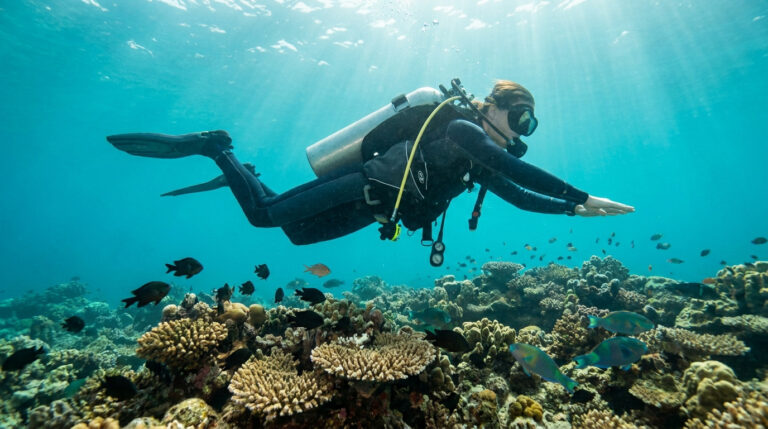
A jacket BCD wraps its air bladder around your torso for an upright, stable feel that new divers find intuitive, while a wing keeps all the lift behind you on a rigid backplate for flatter trim and a more streamlined profile. If you dive a few times a year and want comfort plus easy storage, a jacket is the friendlier pick. If you want better horizontal position, modular parts and room to grow into deeper or twinset diving, a backplate and wing rewards the short learning curve. Neither is wrong; the right answer depends on how, where and how often you dive.
Jacket vs wing BCD at a glance
Before we dig into the detail, here is the quick comparison most divers are really after. Use it as a shortlist, then read the sections below for the reasoning.
| Feature | Jacket BCD | Wing (backplate and wing) |
|---|---|---|
| Where the lift sits | Around your sides and back | Entirely behind you |
| Trim in the water | Tends toward upright | Naturally flat and horizontal |
| Comfort when inflated | Can squeeze the chest at the surface | Front stays open and free |
| Storage pockets | Usually generous | Minimal unless you add pockets |
| Streamlining and drag | More bulk, more drag | Very clean profile |
| Upgrades and repairs | Often replace the whole unit | Swap plates, wings and harness parts |
| Learning curve | Familiar from training | Short adjustment period |
| Best for | New and holiday divers | Frequent, technical and travel divers |
How a jacket BCD works
A jacket BCD, sometimes called a stab jacket, is almost certainly what you wore during your first pool session. The air cell wraps around your waist and shoulders, so when you inflate at the surface it lifts you into a comfortable upright position, a bit like sitting in a floating armchair. That is reassuring for a new diver bobbing beside the boat, and it is a big reason most training centres start students here.
Strengths worth knowing:
- Instantly familiar if you trained in one, so your buoyancy instincts carry straight over.
- Roomy pockets for a torch, surface marker buoy or slate.
- Integrated weight pockets on most models, which keeps a weight belt off your hips.
- Comfortable padding that sits nicely under a rental tank.
The trade-offs show up as you progress. Because the bladder inflates inward as well as outward, a full jacket can press on your chest at the surface and make a relaxed breath harder to take. All that wrap-around material adds buoyancy and drag, so you often carry a little more lead and work slightly harder against the water. Underwater the jacket also nudges you toward a feet-down posture, which is fine for gentle reef cruising but less ideal when you want to hover flat over silt or coral. If you like the jacket format, the Hedgehog jacket BCD at S$512 and the modular Seac Sub Modular BCD at S$680 are honest, comfortable options.
How a wing and backplate system works
A wing setup separates the job into three parts: a rigid backplate against your spine, a horseshoe or doughnut shaped air cell (the wing) that sits between the plate and your tank, and a webbing harness that holds it all to your body. The lift lives entirely behind you, which does two useful things. It keeps your front completely open, so inflating never squeezes your chest, and it encourages a flat, head-slightly-down float that most divers recognise as good trim.
Why experienced and travelling divers gravitate here:
- Excellent horizontal trim straight out of the box, which protects reefs and stirs up less silt.
- A clean profile that cuts drag, so many divers find their air lasts a touch longer.
- Modularity: a steel plate for cold, heavy kit or an aluminium plate for warm-water travel, with the same wing and harness.
- Repairable and upgradeable part by part, rather than binning the whole rig.
- Easy to scale up to a twinset or sidemount as your training grows.
The catch is that a bare harness has no pockets and no built-in cushioning, so you add those yourself, and a metal backplate is less forgiving on your back over a long surface swim. There is also a brief adjustment period while you learn to control lift that all sits behind you. Popular systems on our shelves include the DIR Zone Ring 14 Light aluminium system at S$825, the titanium-core AKUANA Seal wing at S$828, and the complete Hollis Backplate Set at S$862.50. If you want to build gradually, a standalone DIR Zone stainless steel backplate is S$280.
What about hybrid back-inflate BCDs?
You do not have to choose one extreme. Back-inflate hybrids keep the lift behind you for better trim, yet retain a padded jacket-style harness and proper pockets. They are a sensible middle path for divers who want cleaner trim without giving up storage or comfort. The travel-friendly Scubapro Hydros Pro at S$1080 is a good example, and the Hollis L.T.S. BCD at S$980 offers a supportive back-inflate feel. If you are unsure, a hybrid is often the safest first upgrade from a rental jacket.
Which one suits diving from Singapore?
Local conditions matter more than internet debates. Warm-water shore and boat dives at Pulau Hantu and Lazarus Island mean you are in a thin wetsuit, carrying modest lead, and often diving over silty or delicate bottoms where good trim really counts. That leans in favour of a wing or back-inflate for the flatter posture. On the other hand, if you mostly dive on holiday a couple of times a year and value grab-and-go comfort, a well-fitted jacket keeps things simple.
Think about your trajectory too. Divers working through their PADI Open Water, Advanced and Rescue courses at our flat S$838 pricing often find that as their skills sharpen, so does their appetite for the precision a wing delivers. Buying once into a modular system can be cheaper than replacing a jacket later.
A simple way to decide:
- Count your dives per year. Under ten and mostly warm holidays favours a jacket or hybrid.
- Check your goals. Photography, deep, wreck or technical ambitions favour a wing.
- Weigh your travel. Frequent flyers benefit from an aluminium plate and a light wing.
- Be honest about fiddling. If you enjoy tuning your kit, a wing is rewarding; if not, a jacket is fuss-free.
Cost, fit and trying before you buy
Price is rarely the deciding factor because good jackets and entry wings overlap. In our range you can spend from around S$512 for a comfortable jacket up past S$1480 for a premium Surface Tension Infinity wing, with plenty of solid choices in between. What matters far more than the sticker is fit and lift. Get the harness snug so the BCD moves with you, and choose enough lift for your exposure suit and tank without going oversized. Our small classes of four to five divers mean we can put a couple of styles on you in the water and let you feel the difference rather than guess. For more buying guidance, browse our diving guides or drop by the shop at 178 Paya Lebar Road for a fitting.
Frequently asked questions
Is a wing BCD safe for a beginner?
Yes. Plenty of newer divers start on a back-inflate or wing without issue. The main difference is a short habit change, since all the lift is behind you, so you learn to trim flat rather than float upright. A brief orientation dive is usually enough to feel comfortable.
Do I really need a metal backplate?
Not always. A steel plate adds useful ballast for cold water and heavy kit, while an aluminium plate suits warm-water and travel diving. Some divers even use a soft backplate. The plate is one of the easiest parts to swap later, which is a core benefit of the wing system.
Will a jacket BCD hold me back as I improve?
It will not stop you diving well, and many experienced divers are perfectly happy in a quality jacket. That said, if you start chasing better trim, longer air or technical training, you may find a wing or hybrid gives you cleaner results with less lead.
Can I add pockets to a wing setup?
Yes. Webbing harnesses accept clip-on or slide-on pockets for a torch, marker buoy or spare mask, so you are not stuck with a bare rig. Many divers add a single thigh pocket and find that covers most recreational needs.
How much lift should my BCD have?
Enough to float your fully kitted self at the surface and offset your exposure suit, but no more. For warm-water single-tank diving in Singapore, a moderate lift wing or standard jacket is ample. We can confirm the right figure during a fitting once we know your suit and tank.