
Ear Won’t Clear After Diving? Equalisation and Blocked Ear Fixes
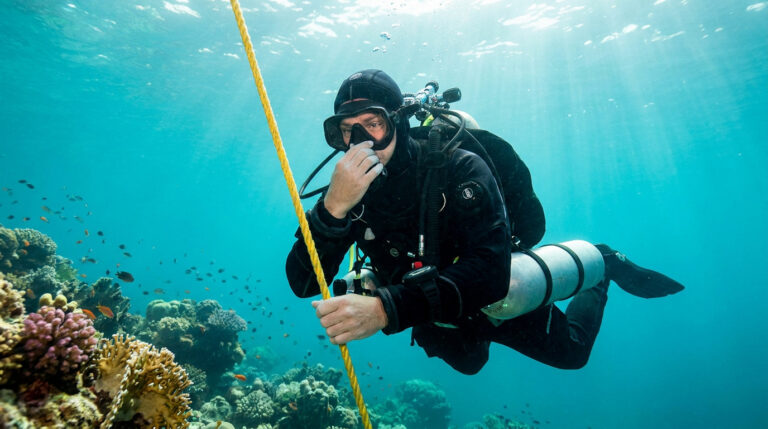
If your ear will not clear after scuba diving, the usual cause is a middle ear that did not fully equalise, leaving a little trapped air or fluid sitting behind the eardrum. Most cases are mild and settle within a few hours to a couple of days. You can help things along by staying upright, swallowing and yawning often, gently trying the Valsalva or Toynbee manoeuvre, and holding off on your next dive until the fullness clears. If the pain is severe, you feel the room spinning (vertigo), or there is any bleeding or discharge from the ear, stop self-treating and see a doctor.
Why your ear stays blocked after a dive
Your middle ear is an air pocket sealed behind the eardrum. The only way to move air in and out of it is through the Eustachian tube, a narrow channel that runs to the back of your throat. When you descend, water pressure squeezes the eardrum inwards, and equalising pushes air up the tube to balance it. When the tube does not open cleanly, the pressure never fully evens out, and you surface with a plugged, muffled, or full feeling.
A blocked ear after diving is almost always a mild form of middle ear barotrauma. Common triggers:
- Diving with a cold, sinus congestion, or allergies that swell the Eustachian tube lining.
- Descending too fast, so pressure builds faster than you can clear it.
- Equalising too late or too hard, which can lock the tube shut instead of opening it.
- Fluid or mucus that seeps into the middle ear during the dive and lingers afterwards.
- Trapped air on ascent, known as a reverse block, which leaves the ear feeling stuffed once you are back on the surface.
The good news is that most divers feel normal again quickly. The blocked sensation is a sluggish tube slowly re-pressurising, not a sign of lasting damage.
How to clear a blocked ear after diving
Work through these steps gently. The golden rule is never to force anything: if a technique hurts, back off. Aggressive blowing can make a mild block worse.
- Stay upright and give it time. Sit or stand rather than lying down. Gravity helps the middle ear drain, and many mild blocks clear on their own within a few hours.
- Swallow, yawn, and chew. Swallowing and yawning are the natural actions that open the Eustachian tube. Chewing gum or sipping water keeps you swallowing regularly.
- Try a gentle Toynbee manoeuvre. Pinch your nose and swallow at the same time. This uses your own throat muscles to coax the tube open, which is softer than blowing.
- Try a soft Valsalva if needed. Pinch your nose and blow very gently, as if inflating a balloon with the smallest possible effort. A tiny controlled push is safer than a hard one.
- Warm and steam. A warm shower, a warm compress over the ear, or breathing in steam can thin mucus and relax the tube.
- Stay hydrated. Drinking water thins the mucus that clogs the tube, so keep your fluids up after a dive day.
Avoid diving, flying, or any other pressure change until the ear feels completely normal again. Going back down on a partly blocked ear is the fastest way to turn a minor niggle into a proper injury.
Equalisation techniques compared
Prevention beats cure, and it starts with knowing more than one way to equalise. If one method is not working on a given day, another often will. Here is how the main techniques stack up.
| Technique | How to do it | Best for |
|---|---|---|
| Valsalva | Pinch your nose and blow gently against it. | Beginners; the most widely taught method. |
| Toynbee | Pinch your nose and swallow. | Clearing on the surface and easing a stubborn ear. |
| Frenzel | Pinch your nose, close the throat, and push the tongue up and back like a piston. | Hands-free, repeatable equalising; favoured by freedivers. |
| Lowry | Pinch your nose, then blow and swallow together. | Divers who find single methods do not quite open the tube. |
| Voluntary tube opening | Tense the throat and push the jaw forward, as in a wide yawn. | Experienced divers who can hold the tube open on descent. |
The Frenzel manoeuvre is often described as the gentlest and most efficient, because it uses your tongue rather than lung pressure. It takes practice, and learning it in a small class where an instructor can coach you one to one is a real advantage.
Reverse block: trapped air on the way up
Most divers worry about equalising on the way down, but a blocked ear after diving is sometimes caused by the opposite. On ascent, the air in your middle ear expands and should vent out through the Eustachian tube on its own. If congestion narrows the tube, that expanding air gets trapped and presses outward on the eardrum. This is a reverse block, and it can leave the ear feeling full or sore once you are back on the surface.
If you feel a reverse block building during ascent, stop, descend a metre or two until the pressure eases, and try to open the tube with a gentle swallow, a yawn, or a soft Valsalva, then ascend slowly. On the surface, treat any lingering fullness like a descent block: stay upright, swallow often, and give it time.
How to prevent a blocked ear on your next dive
Almost every blocked ear traces back to how equalisation was handled on the dive. A few habits make a big difference:
- Equalise early and often. Start gently at the surface and clear every metre or so on the way down, before you feel pressure, not after.
- Descend feet first and slowly. An upright, controlled descent along a line gives the tube time to keep up. A head-first plunge does not.
- Never dive with a cold or blocked sinuses. Congestion is the single biggest reason ears refuse to clear. If you cannot equalise on land, you will not manage it underwater.
- Choose a mask that lets you pinch your nose easily. A soft, low-volume nose pocket makes one-handed equalising simple. Options such as the Seac Sub Italica Asian Fit mask (S$90) and the Atomic Aquatics Sub-Frame mask (S$88) have nose pockets shaped to reach even with gloves on.
- Practise more than one technique. If Valsalva stalls, switch to Toynbee or Frenzel.
- Stop and reset if it will not clear. Ascend a little, try again gently, and continue only once both ears are even.
These skills are drilled from your very first pool session. Our PADI diving courses in Singapore run small classes of four to five students at a flat S$838, so an instructor has time to watch your descents and fine-tune the way you equalise before it ever becomes a problem.
When to see a doctor
Most blocked ears clear within a day or two. See a doctor, ideally one familiar with diving, if you notice any of the following:
- Fullness or muffled hearing that lasts beyond a week or two.
- Severe or worsening ear pain rather than a fading ache.
- Vertigo, a spinning sensation, or loss of balance.
- Bleeding, clear fluid, or discharge from the ear.
- Sudden or noticeable hearing loss.
- Ringing in the ear (tinnitus) that does not settle.
These can point to a burst eardrum, inner ear injury, or infection, and deserve a proper examination. Do not dive again until a professional has cleared you.
Diving around Singapore with healthy ears
Local training dives at Pulau Hantu and Lazarus Island are shallow and forgiving, which makes them a friendly place to build steady equalisation habits. Descents are gradual, so you can clear early and often without rushing.
If you are still getting the hang of it, treat every dive as practice: relax your jaw, clear before you feel pressure, and never chase depth on an ear that is dragging its feet. For more on skills, gear, and dive sites, browse our diving guides.
Frequently asked questions
How long does a blocked ear last after diving?
Mild cases usually clear within a few hours to a couple of days as the middle ear slowly drains and re-pressurises. If fullness, muffled hearing, or discomfort lasts beyond one to two weeks, see a doctor to rule out fluid, infection, or an eardrum injury.
Is it safe to keep diving if my ear will not clear?
No. Diving again on a blocked or partly equalised ear is the fastest way to turn a minor niggle into middle ear barotrauma or a burst eardrum. Wait until both ears feel completely normal, and if in doubt, sit the dive out and get checked.
Why can I equalise one ear but not the other?
Your two Eustachian tubes are independent, and one can be more swollen or sluggish than the other, often the side you had a recent cold on. Tilt your head so the blocked ear points up towards the surface while you equalise, which can help that tube open.
Can I take a decongestant before diving to prevent blocked ears?
Some divers use decongestants, but they can wear off mid-dive and cause a rebound reverse block on ascent, and they are not a fix for diving while genuinely unwell. Speak to a doctor about whether they suit you, and never dive with an active cold.
Does a better mask really help with equalisation?
Indirectly, yes. A mask with a soft, easy-to-reach nose pocket lets you pinch your nose and equalise with one hand, even wearing gloves, so you can clear early and often without fumbling. It does not open the tube for you, but it removes one common excuse for equalising late.