
Phuket Diving from Singapore: Similan, Racha and Day Trips
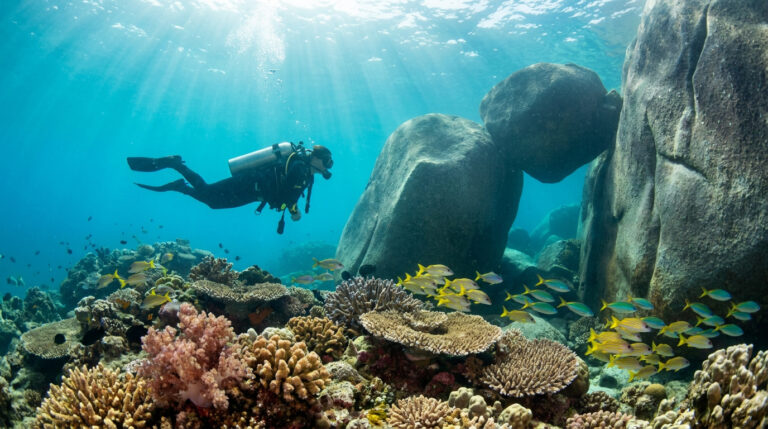
Phuket is the most accessible world-class dive destination for Singapore divers, reachable in under two hours by air. From there two very different experiences open up: multi-day liveaboard trips out to the Similan Islands roughly 60 kilometres offshore, and relaxed speedboat day trips to Racha Yai and Racha Noi just south of the island. This guide explains how to plan each one, when to go, and how to get dive-ready before you fly.
Getting to Phuket’s dive sites from Singapore
Phuket International Airport sits on the north of the island, and flights from Singapore Changi run several times a day at about 1 hour 50 minutes each way. Once you land, the dive area you pick shapes the rest of the trip, because the good sites sit in two different directions.
- Similan Islands: boats depart from Khao Lak or Thap Lamu pier, roughly 90 minutes north of the airport. Best experienced as a liveaboard.
- Racha Yai and Racha Noi: speedboats leave from Chalong Pier in the south, about 45 minutes from the airport. Ideal for single-day diving.
- Phi Phi and Shark Point: also reachable on day trips from Chalong for divers who want more variety close to Phuket town.
Similan Islands: Thailand’s liveaboard headline
The Similans are a chain of uninhabited granite islands inside a protected national marine park. Their appeal is two dive styles in a single trip: gentle sloping coral gardens on the sheltered east side, and dramatic granite boulder swim-throughs on the exposed west side. Signature sites include Elephant Head Rock, Koh Bon and Koh Tachai, and further north, Richelieu Rock, where manta rays and the occasional whale shark pass through on the current.
Because these sites sit far offshore, a liveaboard is the sensible way to dive them. Sleeping on the boat means early-morning and dusk dives when marine life is most active, plus access to remote pinnacles that day boats simply cannot reach in time. Typical Similan liveaboards run 2 to 4 nights and fit 3 to 4 dives per day, so you rack up more bottom time in a weekend than most local trips manage in a month.
Racha Yai and Racha Noi: the day-trip favourites
If you only have one free day, or you are travelling with non-divers who want to stay near the beach, the Racha islands are the go-to. Racha Yai has sheltered, sandy-bottomed bays with easy visibility that make it a popular training and refresher location. Racha Noi, further south, is deeper and more exposed, and is known for the clearest water in the region at around 25 metres on a good day.
A standard Racha day trip runs two dives at Racha Noi and one at Racha Yai. You can expect reef fish, moray eels, sea turtles, and in the right season the chance of a passing manta ray. Because the whole thing is done and dusted in a day and you sleep back in your hotel, it suits divers who want to fold a couple of dives into an otherwise normal Phuket holiday.
Similan liveaboard vs Racha day trip: which suits you?
Both are excellent, but they answer different questions. Use this comparison to match the trip to your experience level and how much of your holiday you want to spend underwater.
| Feature | Similan liveaboard | Racha day trip |
|---|---|---|
| Trip length | 2 to 4 nights aboard | Single day, hotel each night |
| Departure point | Khao Lak or Thap Lamu, north | Chalong Pier, south |
| Dives per day | 3 to 4 | 2 to 3 |
| Best for | Keen divers chasing pelagics | Beginners, refreshers, mixed groups |
| Signature marine life | Manta rays, whale sharks, granite swim-throughs | Turtles, reef fish, mantas at Racha Noi |
| Suggested certification | Advanced Open Water | Open Water (Racha Yai suits beginners) |
When to dive Phuket: the season
The Similan Islands National Park runs a fixed season. It opens around mid-October and closes in mid-May, shutting entirely through the southwest monsoon so the reefs can recover and conditions stay safe. The prime diving window is November to April, when the seas are calm and visibility is at its best. Late February often brings stronger currents that pull in the larger pelagics. Water stays warm and comfortable through the whole season, typically 26 to 29 degrees Celsius, so a 3mm wetsuit is plenty.
- November to April: prime season, calm seas, best visibility.
- Mid-October and early May: quieter shoulder weeks with fewer boats.
- Mid-May to mid-October: Similan park closed, though southern day trips to Racha can still run on calmer days.
Get certified in Singapore before you fly
You do not have to arrive in Phuket already qualified, but training at home first means you spend your holiday diving rather than sitting through coursework. Our PADI courses in Singapore cover Open Water, Advanced Open Water and Rescue Diver at a flat S$838, taught in small classes of four to five students so you actually get looked after. Confined and open-water training dives happen locally at Pulau Hantu and Lazarus Island, and the shop is at 178 Paya Lebar Road #03-03.
An Advanced certification pays off in the Similans in particular, since several of the best sites sit below 18 metres and reward divers who are comfortable with depth and mild current. If you are still weighing Phuket against closer options, our guide on where to dive from Singapore lines up the regional alternatives side by side.
What to pack for warm-water Phuket diving
Boats provide tanks and weights, but a well-fitting mask, comfortable fins and your own dive computer make every dive better, especially on the repetitive multi-dive days of a liveaboard.
- Dive computer: track no-decompression limits across three or four dives a day. The Scubapro Aladin A1 at $470 or the Atmos Mission 3 at $595 cover recreational needs, while the Garmin Descent G2 at $1050 doubles as a smartwatch.
- Wetsuit: a 3mm suit such as the Scubapro Sport 3mm at $235 is right for 26 to 29 degree water.
- Mask and fins: the Gull Aqua Pro Mask at $78 and Mares Avanti Quattro Plus fins at $140 travel well.
- Dry bag for the boat: the Gull Water Protect Shoulder Bag at $115 keeps phones and cameras dry on the crossing.
For more trip planning, browse the rest of our dive guides before you book.
Frequently asked questions
Do I need to be a certified diver to dive in Phuket?
For proper reef dives, yes. Many operators offer a Discover Scuba experience for total beginners, but you get far more out of the trip if you complete your Open Water certification in Singapore first and arrive ready to dive.
Is the Similan Islands better as a liveaboard or a day trip?
A liveaboard. The best Similan sites sit 60 kilometres offshore, and staying on the boat gives you early and late dives plus access to remote pinnacles like Richelieu Rock that day boats cannot reach in time.
When is the best time to dive the Similan Islands?
November to April, inside the official park season that runs from about mid-October to mid-May. The park closes entirely through the southwest monsoon, so plan around that window.
Can beginners dive at the Racha islands?
Yes. Racha Yai has sheltered, sandy-bottomed bays with easy visibility that suit newly certified divers and refreshers, while the deeper Racha Noi sites are better once you have some experience.
What certification should I have before a Phuket trip?
Open Water is enough for the Racha day trips. For the deeper Similan sites, Advanced Open Water is strongly recommended, and both can be completed locally at our flat S$838 course price.