
BCD Buying Guide: How to Choose a BCD in Singapore
A BCD (buoyancy control device) is the harness-and-bladder system that carries your tank, holds your weights, and lets you hover mid-water or float at the surface. It is the piece of kit your whole rig hangs off, and the one where fit matters more than brand. This guide covers the four styles, how much lift you actually need in tropical water, sizing, and what we stock in Singapore with real prices, written by the team that dives this gear every week.
The four BCD styles, honestly compared
Every BCD does the same job. The styles differ in where the air sits and how the harness is built, and that changes how each one feels underwater and at the surface.
| Style | Underwater | At the surface | Best for |
|---|---|---|---|
| Jacket (vest) | Bulkier, more drag; air squeezes your torso when full | Very stable, floats you upright | Courses, rentals, first dives |
| Back-inflate | Cleaner trim; air sits behind you around the tank | Slight face-forward push until you learn to lean back | Divers past the beginner stage |
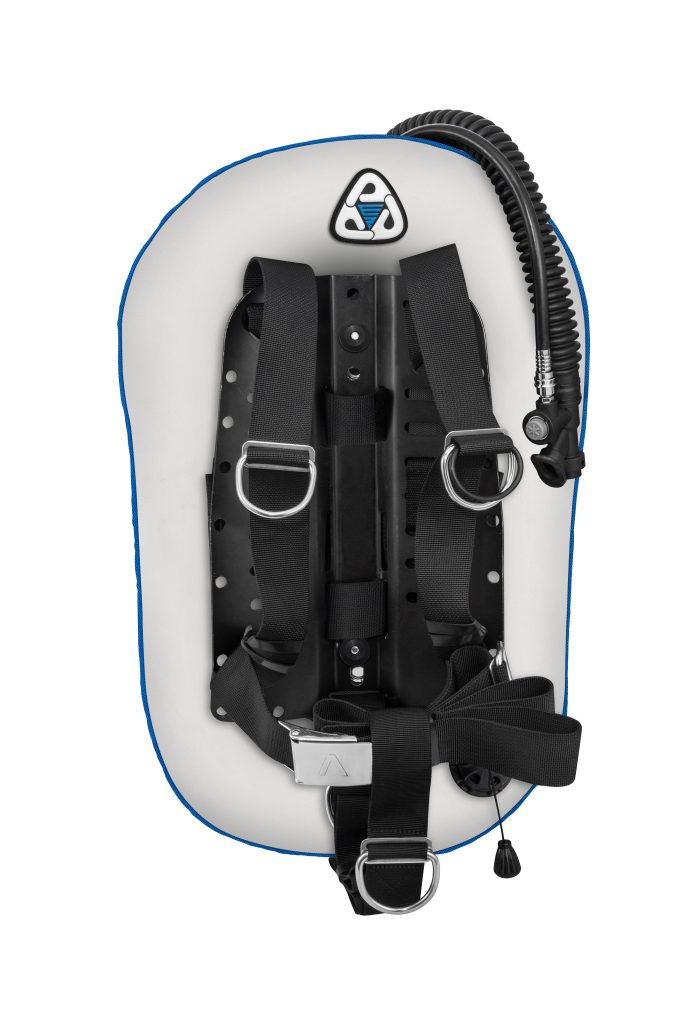
| Backplate & wing | Flattest trim, least drag; fully modular | Same lean-back habit; minimal padding | Frequent divers, travel, future tech |
| Travel | Light fabrics, smaller lift; usually back-inflate | Fine in warm water | Flying to dive trips with thin suits |
The jacket is what you almost certainly wore during your Open Water course, because it is the easiest thing for a school to fit onto many bodies. It is a fine tool, but we will be straight with you: we rarely stock jackets, because the divers who buy their own BCD here are choosing better trim and less drag. Our shelf is built around backplate-and-wing systems and back-inflate designs, and this guide explains why that suits diving from Singapore.
PADI’s own position is that at recreational level the style you dive “isn’t going to affect your diving” once you are proficient with it. Translation: there is no wrong answer, only trade-offs. Buy the one that matches where your diving is going, not just where it started.
How much lift do you need?
Lift is the buoyant force of the fully inflated bladder, quoted in kilograms or pounds. Under the European EN 1809 standard it is measured in Newtons, and roughly 10 N equals 1 kg of lift, so a “300 N” wing is about 30 lbs.
Here is the number that surprises most buyers: diving a single aluminium tank in 29-30 degree water with a 3 mm suit, your real underwater requirement is small. The gas in a full tank weighs about 3.5 kg and a thin tropical suit loses only a kilo or two of buoyancy at depth. Everything above roughly 6 kg of lift is surface-flotation margin.
- Tropical single-tank diving (Tioman, Bali, most of what we do from Singapore): a 20-30 lb (9-14 kg) wing is the standard recommendation, and it is why most of our single-tank wings are 20, 25, or 30 lb.
- Rule of thumb: your lead plus about 10 lb of margin. Carrying 6 kg of lead? Around 10 kg (22 lb) of lift covers you.
- Doubles and technical rigs: 40-50 lb wings exist for a reason, and we stock them, but they are the wrong tool for a single AL80.
More lift is not more safety. An oversized bladder folds around your tank like a taco, adds drag, and burns your gas. Buy the correct size and the lift takes care of itself.
Fit: the thing that actually matters
A BCD is sized by torso length, not T-shirt size. Too long and the tank valve hits the back of your head; too loose and the whole rig shifts when you roll. Snug without squeezing is the target, and the only reliable test is wearing it, ideally with a tank on. That is the honest advantage of buying from a shop with a floor: come in, put it on, and we will fit it properly. One system in our range, the Scubapro Hydros Pro, even uses a heat-mouldable gel harness that shapes itself to you over the first few dives.
On a backplate-and-wing, fit works differently: the one-piece webbing harness is cut to you exactly, once, and a steel plate is itself about 2.7 kg (6 lb) negative, which is lead you take straight off your weight pockets.
Integrated weights or a belt?
Most modern BCDs carry your lead in two quick-release pockets at the hips, dropped with a single pull in an emergency, usually with two smaller trim pockets near the tank to fine-tune your balance. Integrated weights make gearing up easier on a rocking boat and spare your hips on the surface swim. The trade-off is a heavier BCD in your luggage. A simple weight belt still works, weighs nothing when packed, and stays our recommendation for divers who fly with strict baggage limits and rent lead at the destination. We stock weight systems and belts either way.
Flying to dive? Weight is the spec that matters
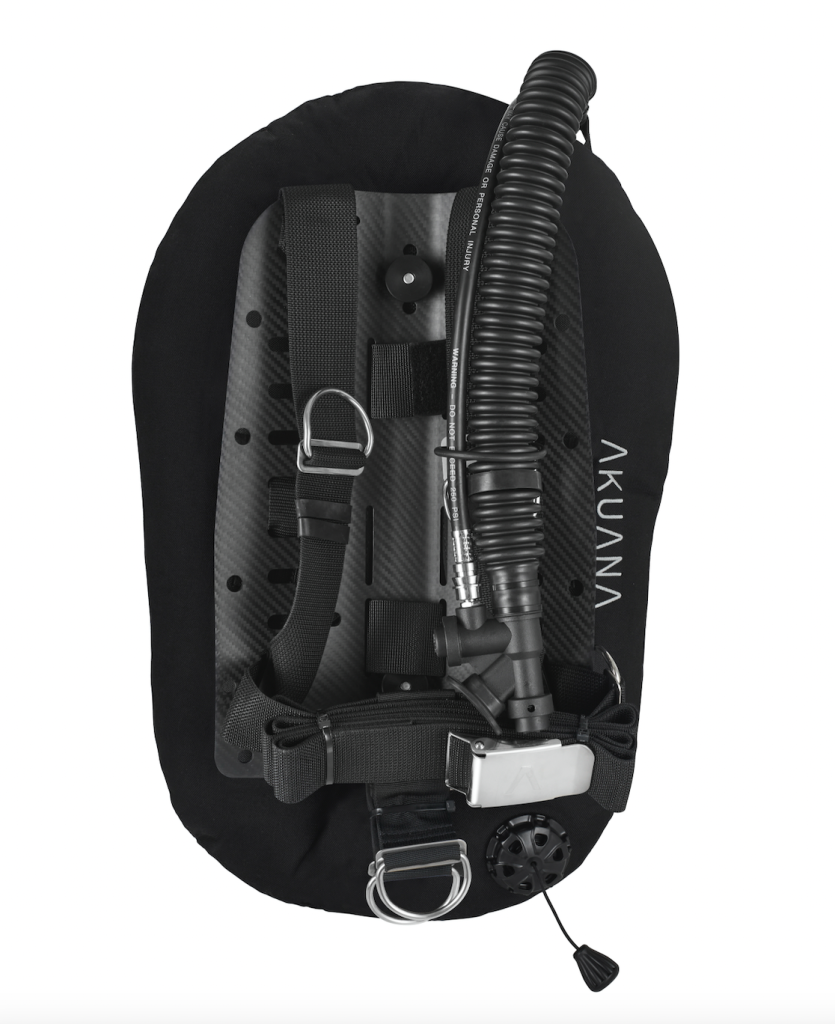
Singapore diving mostly means a flight or a ferry: Tioman, Bali, Komodo, Anilao. Every kilogram of BCD is a kilogram of baggage allowance. A traditional jacket BCD runs 3.5-4 kg. A travel back-inflate runs closer to 2.5 kg. A backplate-and-wing with an aluminium or carbon plate splits the difference while staying modular: our Akuana Seal carbon set and the DIR Zone Ring 14 Light exist precisely for this. Lighter fabrics (210-denier rather than the 1000-denier armour of rental jackets) save weight too; the trade is abrasion resistance, which matters less when the BCD only sees warm, easy water.
What we stock, and who each one is for
Every model below is in our own Singapore warehouse (two exceptions noted), and every price is in SGD. This is the actual shelf, not an affiliate list.
Backplate and wing, single tank
- Akuana Seal Elite aluminium set, from $750: our entry point into BP/W, from the BCD brand divers search this site for most. Complete set: plate, harness, wing.
- Akuana Seal titanium core, $828: the same platform with a titanium plate for corrosion resistance and low weight.
- Akuana Sonic, $965: the refined version, donut wing and low-profile hardware.
- Surface Tension Infinity, $1,480: the premium single-tank wing in the range, for divers who want the last word in build.
Back-inflate
- Seac Modular, $680: straightforward back-inflate, the gentlest price into owning something better than a rental.
- Scubapro Hydros Pro, $1,080: mouldable gel harness, packs small, arguably the most comfortable BCD we sell.
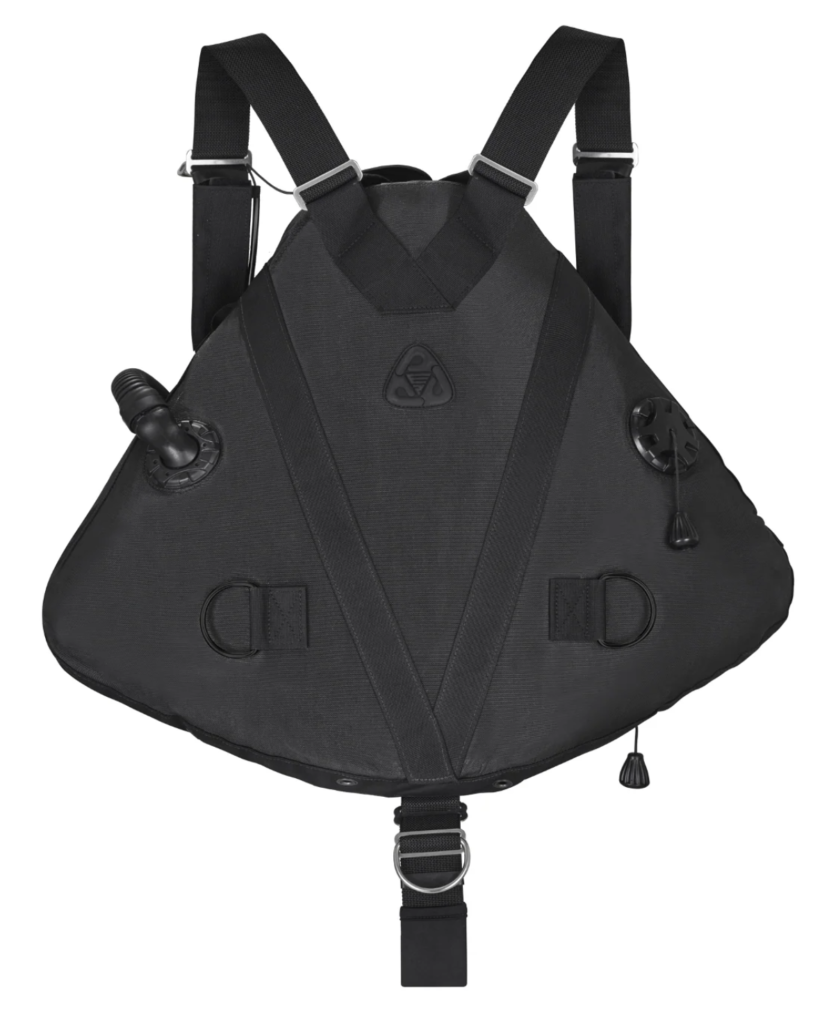
Sidemount
- xDeep Stealth 2.0 Rec, $990, and Stealth 2.0 Classic, $950: the cave-proven standard, in recreational and classic cuts.
- Akuana Black Manta, $928: high lift, easy adjustment, built for long multi-tank dives.
Doubles and technical
- Akuana Tales 50 lb double-tank set, from $900, and the Seal 50 lb SS set, from $850, when your diving grows twin tanks.
Two Hollis favourites, the L.T.S. travel BCD and the SMS 100 sidemount, are on 4-6 week pre-order at the moment; the product pages show live status.
Looking after your BCD
- After every dive trip, soak in fresh water, and rinse the inside of the bladder: fill a third with fresh water through the inflator, slosh, drain, then leave it to dry partly inflated.
- Rinse the inflator mechanism while pressing the buttons; salt crystals in the inflator are the most common failure we service.
- Store partly inflated, out of the sun, hanging or flat, never folded tight.
- Have the inflator and dump valves serviced annually alongside your regulator.
Frequently asked questions
What does BCD stand for?
Buoyancy control device, also called a BC or, in Europe, a stab jacket. Same thing: the inflatable harness that carries your tank and controls your buoyancy.
Is a jacket or a wing better for a newer diver?
You learned in a jacket, and you can absolutely keep diving one. But if you are buying your own BCD, a back-inflate or backplate-and-wing gives you flatter trim and less drag, and most divers adapt within a couple of dives. The surface lean-back becomes automatic almost immediately.
How much does a BCD cost in Singapore?
From our shelf: $680 for the Seac Modular back-inflate, $750-$965 for a complete Akuana backplate-and-wing set, $1,080 for the Scubapro Hydros Pro, up to $1,480 for the Surface Tension Infinity. Complete sidemount systems run $928-$1,250.
Can I fly with a BCD?
Yes. Empty the bladder fully and pack it in the middle of your bag. A travel back-inflate adds about 2.5 kg to your luggage; a jacket closer to 4 kg; an aluminium or carbon backplate set sits between. Remove the weights first, obviously.
Should I keep renting instead?
Renting makes sense for your first handful of dives. The case for owning is fit (your harness, adjusted once, correct every time), hygiene, and consistency: rental fees across a few trips add up to a set of your own, and your buoyancy improves fastest on gear that behaves the same way every dive.
What size BCD do I need?
Sizes run XS to XL but cut varies by brand, and lift often changes with size on the same model. Torso length decides more than weight. The only reliable answer is trying it on; bring your usual exposure suit thickness in mind and we will fit you in the shop.
Still deciding? Drop by the store and put three different styles on your shoulders in ten minutes, or browse the full BCD range with live stock. Buying a course instead? Your gear discount starts the day you certify with us.